August 20, 2026 • Declan Merritt • 11 min reading time • Prices verified June 17, 2026
Camera Gimbal Tracking Showdown: DJI RS 4 vs RS 5 vs FeiyuTech SCORP-C for Solo Shooters
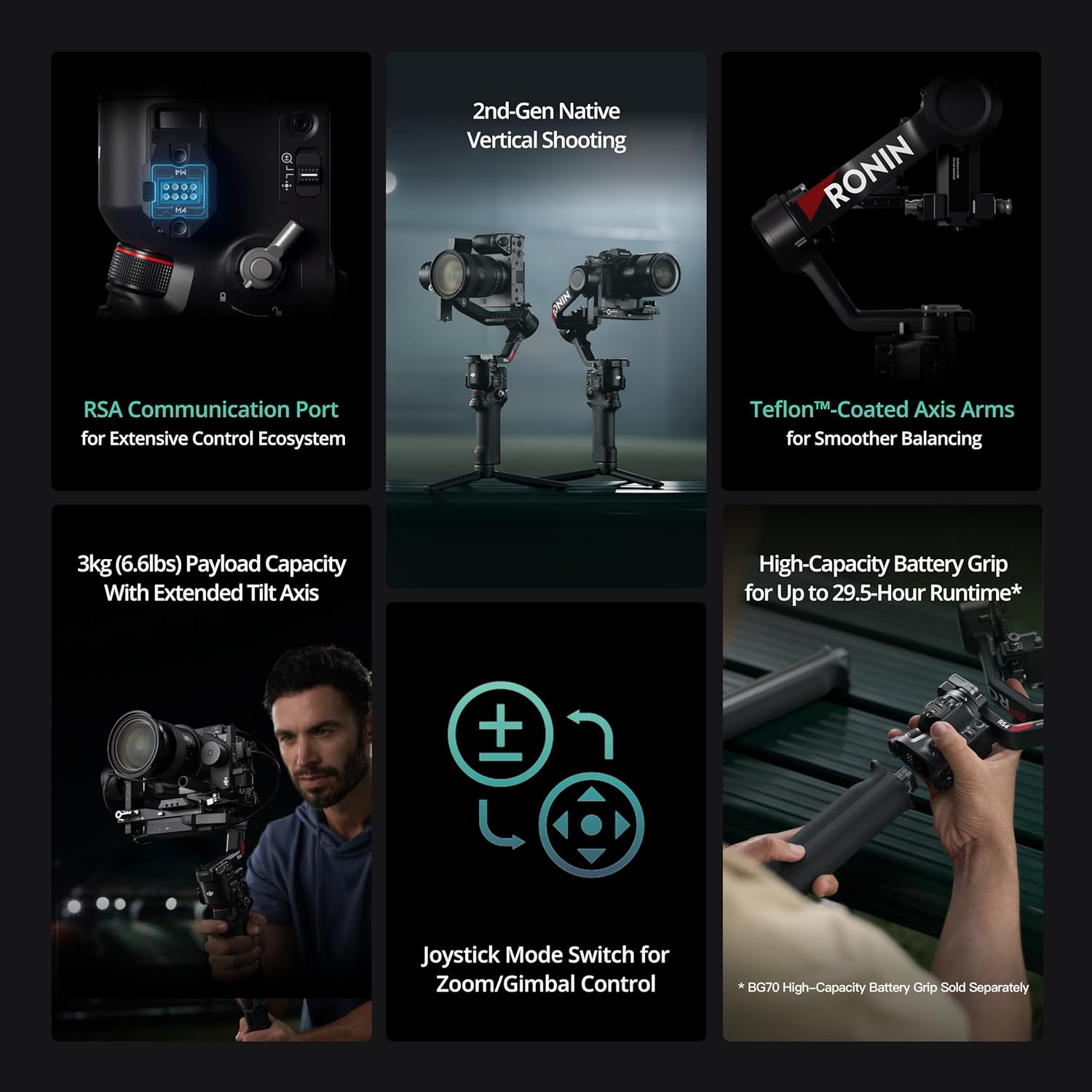
A gimbal is a motorized handheld rig that counteracts camera shake in real time — three motors (for tilt, pan, and roll axes) keep your camera level and smooth even when you’re walking, running, or pivoting. If you’ve ever watched buttery-smooth footage from a wedding film, a travel vlog, or a corporate brand piece shot by one person, a gimbal almost certainly made it possible. For solo shooters specifically — one operator, no dedicated camera assistant — the gimbal has to do more than stabilize. It increasingly has to help you get yourself into the shot, track a moving subject without a second pair of hands, and balance a heavy professional camera body with fast, professional glass. That’s the operating context for this comparison.
The DJI RS 4, RS 5, and FeiyuTech SCORP-C each land in different spots along that spectrum. The RS 4 is a mature, proven platform that a lot of working shooters already trust. The RS 5 is DJI’s latest push into semi-autonomous solo operation, with a tracking module that has drawn genuine attention from independent reviewers. The SCORP-C is the outlier — a differently-shaped tool that has been surprising operators running professional Sony bodies with heavy glass. If you’re deciding between these three right now, here’s the decision frame.
Payload Reality: What These Gimbals Actually Carry
Manufacturer payload specs are always optimistic. They represent a balanced rig in a controlled condition — not your mirrorless body, a fast zoom, a cage, and a wireless follow-focus receiver sitting on top. The working rule across experienced operators is to treat published payload as a ceiling, not a target, and aim to use 70–80% of rated capacity for reliable, consistent stabilization. B&H Photo’s gimbal buying guide recommends that shooters calculate their full rig weight — body, lens, accessories, and mounting hardware — before comparing it to any manufacturer’s rated capacity, and treats the rated figure as a maximum rather than a working target.
By the numbers (from manufacturer specifications):
- DJI RS 4: rated at 3 kg (6.6 lb) payload
- DJI RS 5: rated at 4.5 kg (9.9 lb) payload
- FeiyuTech SCORP-C: rated at 3 kg (6.6 lb) payload
That 1.5 kg gap between the RS 4 and RS 5 is meaningful in practice. A Sony FX6 body with a 70–200mm f/2.8 zoom and a standard cage will push comfortably past 2.8 kg. On the RS 4, you’re near the ceiling. DPReview’s comparative coverage of the DJI RS series has noted that RS 4-class gimbals begin to show strain — slower motor response, horizon drift — with heavy zoom lenses on professional bodies. The RS 5’s higher-rated motors give you real headroom there. The SCORP-C’s 3 kg rating looks identical to the RS 4 on paper, but operator reports have been notably different: shooters running a Sony FX3 body with a large zoom have described the SCORP-C as performing well at its stated ceiling, suggesting FeiyuTech’s motor tuning may be more conservatively rated than its spec implies. The FX3 is a lighter body than the FX6, which matters — but the consistency of that feedback across independent sources is worth noting.
If your current rig is a Sony A7 IV or Fujifilm X-H2S with a standard prime, all three gimbals have headroom to spare. If you’re running an FX3 or Canon EOS R5 C with a heavy zoom and any accessories, the RS 5 is the only one of these three where you’re not managing to a ceiling.
Stabilization and Tracking: Where These Three Gimbals Diverge
DJI RS 4 — Proven Stabilization, Phone-Dependent Tracking
Stabilization on the RS 4 is genuinely competitive within its 3 kg payload limit. Operator feedback aggregated across long-run editorial coverage consistently describes the RS 4’s stabilization as rock-solid — smooth tilt response, reliable horizon lock, quick to balance. No Film School’s coverage of gimbal stabilization workflows makes the point that shooting technique — smooth walking gait, controlled pivots, avoiding abrupt direction changes — closes a large percentage of the performance gap between any stabilized platform and the next tier up. In other words, if smooth stabilization is your primary need and your rig is under 2.5 kg, the RS 4 will serve you well without requiring the RS 5’s price premium.
Tracking on the RS 4 is app-dependent. Subject tracking requires a paired phone mounted to the rig, which introduces battery drain, weight offset, potential Bluetooth lag, and one more variable to manage on a solo shoot. For a shooter who rarely needs to appear on camera themselves, this is a manageable workflow. For a shooter who regularly needs to track themselves or a moving subject without a camera assistant, it is a friction point rather than a solution.
DJI
$469.00
In stock on Amazon
Check price on AmazonDJI RS 5 — The Autonomous Tracking Argument
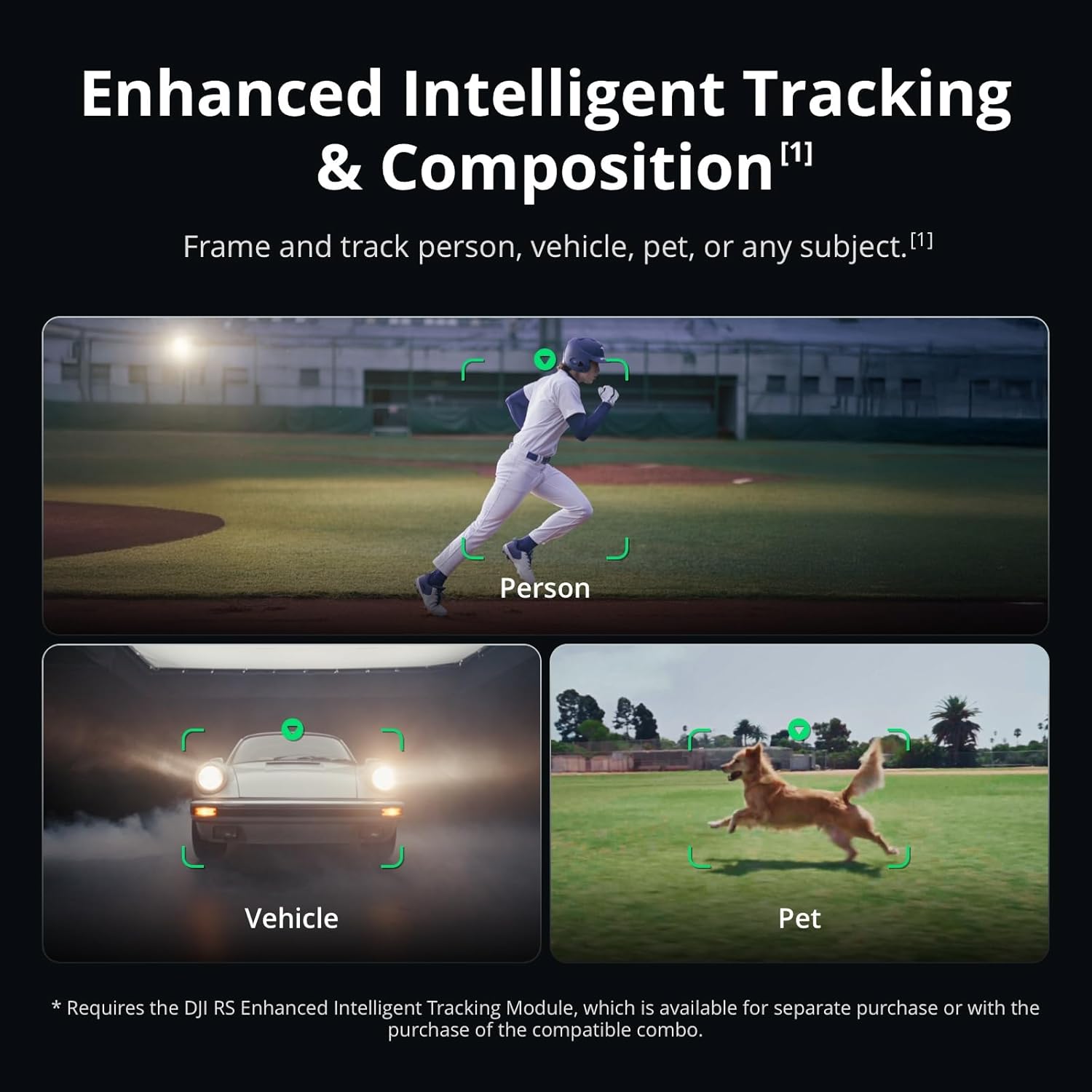
The RS 5’s categorical argument for solo operators is its dedicated tracking module — a clip-on unit with its own front-facing camera and onboard processor that enables subject tracking without a phone connection. Cinema5D’s preview coverage of the RS 5 identified the tracking module specifically as the feature most likely to shift the RS 5 from “incremental upgrade” to “meaningful tool for solo operators” — particularly for travel content, family documentary-style work, and solo brand content where the shooter needs to appear on camera and move naturally without freezing their blocking to a locked-off tripod. That editorial assessment aligns with the operational logic: phone-dependent tracking is a workaround; the RS 5’s module is a purpose-built solution.
The RS 5 also includes a live camera feed feature that transmits a real-time image to an attached control arm, giving operators a monitor view when the camera is at a high angle or extended arm position where the rear LCD is inaccessible. PremiumBeat’s guides to solo shooting workflows have consistently identified frame confidence — knowing what you’re capturing without breaking to check a monitor — as one of the top friction points for one-person productions. The RS 5 addresses that directly. Combined with the 4.5 kg payload ceiling, the RS 5 is the only gimbal in this group where a professional body, a heavy zoom, and a cage can coexist without the operator managing to a motor limit.
DJI
$569.00
In stock on Amazon
Check price on AmazonFeiyuTech SCORP-C — Ergonomics and Payload Efficiency
The SCORP-C’s tracking is app-dependent and functional, but it is not designed around the same autonomous solo-shooting use case as the RS 5’s dedicated module. If tracking is the primary reason you are considering a gimbal upgrade, the SCORP-C is not the answer. Its tracking workflow requires a paired phone, and the operational friction that creates on fast-moving solo shoots is the same friction the RS 5 was engineered to eliminate.
Where the SCORP-C earns its place in this comparison is ergonomics and motor efficiency. The SCORP-C uses a longer, more horizontal grip geometry that operators frequently describe as more comfortable for extended single-hand holds and low-angle shooting. Adorama’s product coverage of the SCORP-C identifies the ergonomic distinction as one of the first things operators flag after extended use — for a solo shooter doing a multi-hour documentary day or a full-day corporate shoot, grip fatigue compounds fast, and the SCORP-C’s handle design meaningfully reduces it. Operators running a Sony FX3 body with a large zoom have described the SCORP-C as performing well at its rated 3 kg ceiling, with motor tuning that appears conservatively rated relative to its specification. That feedback is consistent enough across independent editorial sources to take seriously, though the FX3’s lighter body weight relative to the FX6 or FX9 is part of why those combinations work.

FeiyuTech
$189.00
In stock on Amazon
Check price on AmazonForm Factor, Setup Speed, and Ecosystem Fit
Setup time is a real operational variable on fast-moving solo shoots. The RS 4 has been consistently praised for quick balancing — DPReview’s gimbal coverage has noted that DJI’s balance process has become one of the fastest in the category. The SCORP-C earns similar feedback: operators in long-run reviews note that balancing is intuitive and fast, particularly for shooters who swap lenses or bodies between setups. The RS 5 adds the step of attaching and configuring the tracking module, which adds time to initial rig setup. That is not significant for a planned narrative shoot, but it is worth factoring into a fast-moving run-and-gun day where you are picking up and putting down the rig repeatedly.
For ecosystem lock-in, the RS 4 and RS 5 share DJI’s accessory rail and focus motor system. If you are already running DJI follow-focus hardware or accessory rails, either DJI gimbal stays within that ecosystem cleanly. Moving to the SCORP-C means evaluating your existing accessories for compatibility — a cost that is easy to underestimate until you are repricing lens motors and mounting plates. Provideocoalition’s gimbal workflow coverage has noted ecosystem compatibility as one of the most commonly underweighted factors in solo operator purchasing decisions, particularly for shooters who have already invested in a proprietary follow-focus system.
Is the RS 5 Worth the Premium? The Decision Frame
After DJI’s mid-2025 pricing adjustments, the gap between RS 4 and RS 5 narrowed. The RS 5 is still the more expensive tool, but the premium is no longer at the level where it felt like a categorically different tier of purchase decision. The honest framing is this:
If your rig is under 2.5 kg and you don’t need to get yourself into the shot, the RS 4 is the better value. It stabilizes confidently at that payload, balances fast, and the cost difference goes back toward glass or a quality tripod.
If you regularly run a professional body with a heavy zoom, or if autonomous tracking for solo on-camera work is a genuine production need, the RS 5 pays for its premium. The payload headroom and tracking module together solve real problems; you are not paying for features you will not use.
If your shoots are long single-operator days with frequent rig changes and grip fatigue is a real concern, the SCORP-C deserves a serious look — especially if your camera body stays in the FX3 or A7-class weight range. The ergonomic distinction and motor tuning feedback are consistent enough across independent operator and editorial coverage to take seriously.
Frequently Asked Questions
Is the RS 5 worth the premium over the RS 4 after the price drop? For payload-limited rigs — heavy zooms on professional bodies — and solo operators who need autonomous tracking, yes. The RS 5’s motor capacity and tracking module solve real production problems. For lighter builds where stabilization alone is the goal, the RS 4 remains excellent and the premium is difficult to justify.
Can the SCORP-C really handle a Sony FX3 with a heavy zoom lens? Operators running that combination — FX3 body, large zoom — have described the SCORP-C as performing well at its rated ceiling, with motor tuning appearing conservatively rated relative to its specification. The FX3 is a lighter body than the FX6 or FX9, which helps significantly. That said, you are operating near the SCORP-C’s stated 3 kg limit; balance your rig carefully and avoid adding cage accessories without re-evaluating total payload.
Does the RS 5 tracking module work without a phone connected? Yes. The RS 5’s tracking module operates independently — it has its own front-facing camera and onboard processor. You do not need a phone paired or mounted to use active subject tracking. This is one of the meaningful workflow improvements over the phone-dependent tracking approaches used by the RS 4 and SCORP-C.
How does setup time compare across all three gimbals for a solo run-and-gun shooter? The RS 4 and SCORP-C are broadly comparable — both are noted for intuitive, fast balancing in operator and editorial reviews. The RS 5 adds module attachment and configuration as an additional step, which matters more for reactive shooting days than for planned narrative setups. If you are picking up and re-rigging the gimbal multiple times per hour, that extra step accumulates.
What is the RS 5 live feed feature and do you actually need it? The RS 5 can transmit a live camera image to a secondary control arm, giving you a monitor view when the camera is at an angle or height where you cannot see the rear LCD. For solo operators shooting high-angle or extended-arm moves, this removes the need for a separate video transmitter or monitor arm. If you shoot primarily at eye level with standard framing, you will likely not use it. If unconventional or high-angle framing is part of your regular toolkit, it is a genuine workflow benefit rather than a spec-sheet feature.
Knowing which of these three gimbals actually matches your current rig — body, glass, accessories, and total payload — is the fastest way to avoid a costly return. Check the RS 5’s payload specs against your full rig weight before deciding whether the tracking module justifies the price step, or whether the RS 4 or SCORP-C is the right tool for your production reality.