September 3, 2026 • Declan Merritt • 10 min reading time • Prices verified June 17, 2026
Phone Gimbal Upgrade Guide: DJI Osmo Mobile 7 vs 7P vs 8 — What You're Actually Paying For
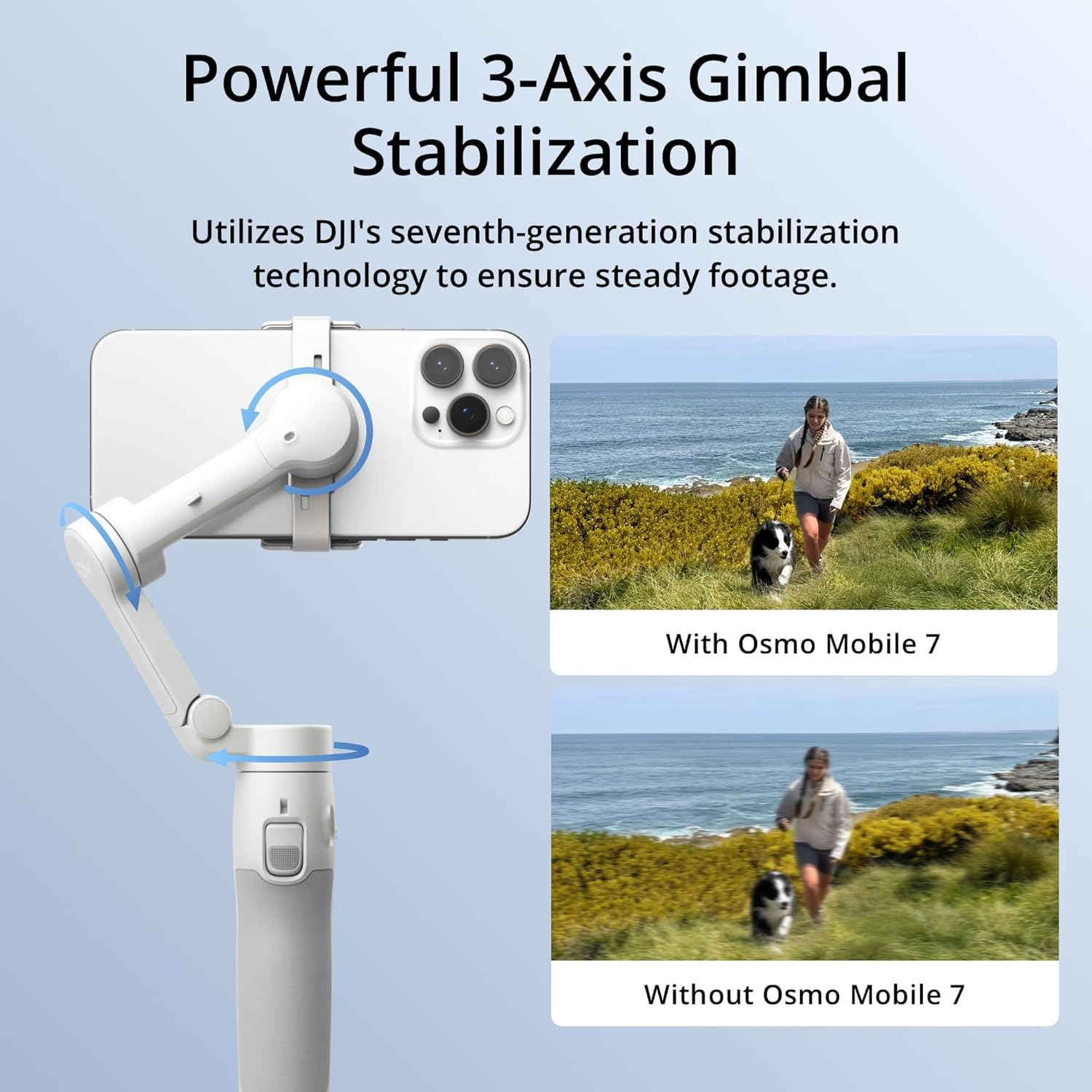
A phone gimbal is a handheld motorized stabilizer — a device with small electric motors that keep your smartphone level and smooth while you walk, run, or pan, eliminating the shaky footage that even the best optical image stabilization can’t fully cure on its own. If you’ve ever watched a vlog where the camera glides effortlessly through a crowded street or tracks a subject’s face across a room without any wobble, there’s a good chance a gimbal was doing the work behind the scenes. DJI’s Osmo Mobile line is the category benchmark: widely reviewed, consistently stocked, and available at three distinct price and feature points right now. This guide cuts through the confusion between the DJI Osmo Mobile 7, the DJI Osmo Mobile 7P, and the DJI Osmo Mobile 8 — explaining what you actually get at each tier, where the real differences live, and which model maps to your current workflow.
You’re probably here because the product pages look suspiciously similar and you don’t want to overpay for features you’ll never use — or, equally, underbuy and regret it six months into a project that demands the one capability you passed on. Let’s run the comparison the way it should be run: specs first, then real-owner patterns, then a clean decision rule.
| EDITOR'S PICKDJI Osmo Mobile 8 Advanced Trac… | Mid-tierDJI Osmo Mobile 7P Gimbal Stabi… | Budget pickDJI Osmo Mobile 7 Gimbal Stabil… | |
|---|---|---|---|
| 360° pan | ✓ | — | — |
| Ext. rod | ✓ | ✓ | — |
| Lighting | ✓ | ✓ | — |
| Tracking | AI tracking | Native tracking | ActiveTrack 7.0 |
| Price | $125.00 | $99.00 | $59.00 |
| See on Amazon → | See on Amazon → | See on Amazon → |
The Quick Version: Where the Three Models Actually Differ
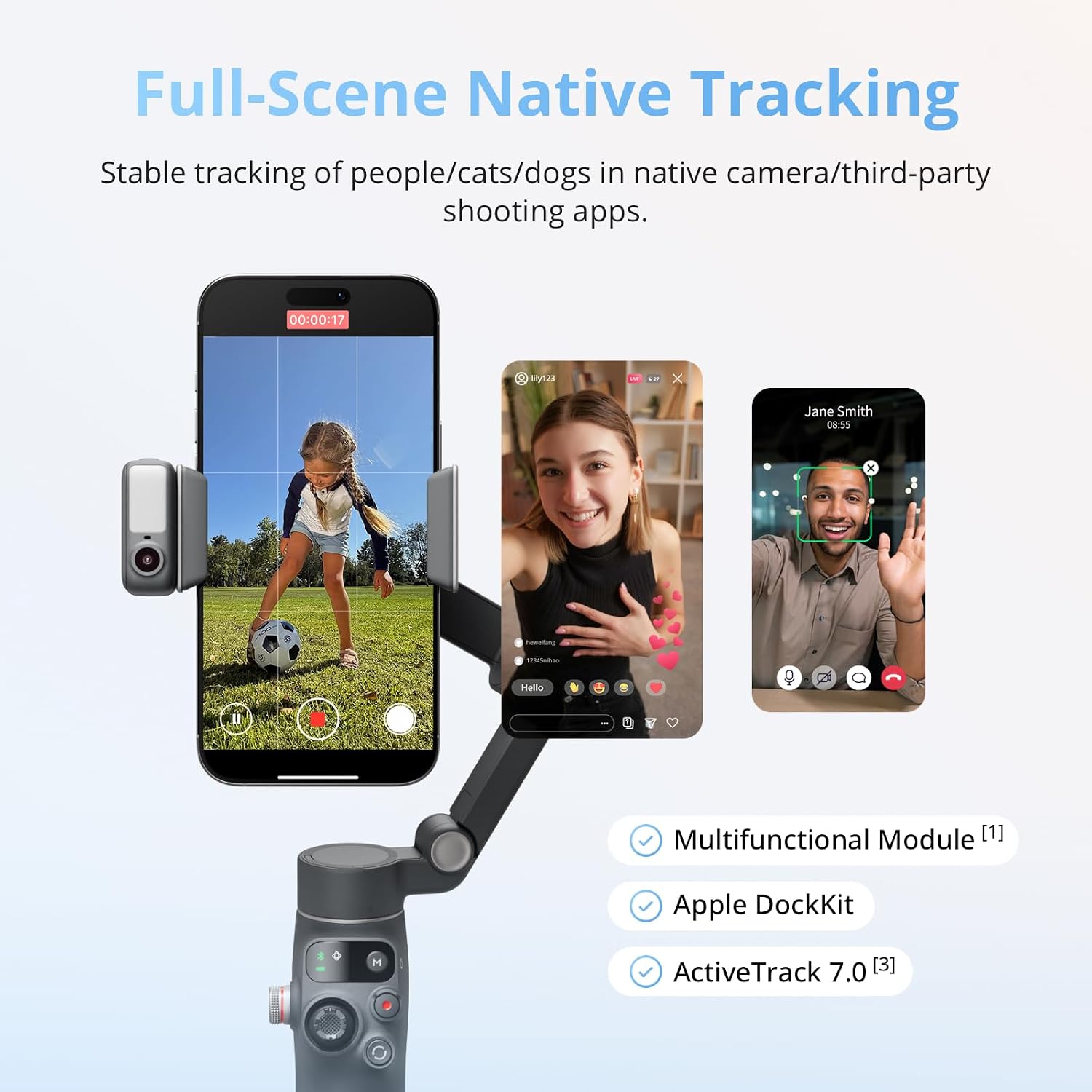
All three gimbals share DJI’s proven 3-axis stabilization platform, fold flat for travel, and work inside the DJI Mimo app (iOS and Android) to unlock features like ActiveTrack subject-following, gesture control, and timelapse modes. At that baseline level, the stabilization quality across all three models is genuinely impressive. PremiumBeat’s roundup “Best Phone Gimbals for Video Creators” describes smooth results that surprise first-time gimbal buyers who expected a steeper learning curve — a pattern that holds across the full Osmo Mobile lineup.
The divergence is in how tracking works and what form factor the gimbal ships in. The table below maps the critical differentiators per DJI’s published product specifications.
| Feature | Osmo Mobile 7 | Osmo Mobile 7P | Osmo Mobile 8 |
|---|---|---|---|
| ActiveTrack Method | App-based (screen tracking) | External optical module | App-based + improved algorithms |
| Max Payload | 300 g | 300 g | 360 g |
| Foldable | Yes | Yes | Yes |
| Tracking Module | No | Included | Optional add-on (Combo SKU) |
| DJI — $59.00 | ✓ | ||
| DJI — $99.00 | ✓ | ||
| DJI — $125.00 | ✓ |
The OM8’s 360 g payload spec is a meaningful upgrade over the shared 300 g ceiling on both OM7 variants — relevant if you’re running a large-format Android device like a Samsung Galaxy S25 Ultra with a case attached.
Head-to-Head: Each Model’s Defining Use Case
The Osmo Mobile 7 — The Honest Value Tier
The base OM7 delivers the same core stabilization engine that reviewers praised at launch, and it does so at the lowest entry price in the current lineup. App-based ActiveTrack runs subject-detection algorithms through your phone’s processor in real time, which means tracking is effective for standard configurations — filming a friend, following a moving subject from behind the camera, or capturing your own front-facing content for social video.
Where the OM7 shows its ceiling is solo rear-camera work. Because app-based tracking requires the phone’s screen to detect your face or body, self-filming with the rear main lens demands that you either work with a partner operating the gimbal, find a creative angle that puts you in the frame reliably, or accept the quality trade-off of the front-facing camera. For creators who shoot with a partner or whose content is front-camera-native, that ceiling never presents itself.
Wirecutter’s buyer’s guide “The Best Phone Gimbal” flags payload ceiling as one of the first specifications to verify before purchasing any phone gimbal, because exceeding the rated maximum produces jerky motor behavior that makes first-time buyers assume they’ve received a defective unit. The OM7’s 300 g limit is comfortable for most mid-size smartphones, but worth confirming against your specific device weight in its shooting configuration — phone plus case plus any attached accessories.
DJI
$59.00
In stock on Amazon
Check price on AmazonThe Osmo Mobile 7P — The Solo Creator’s Tool
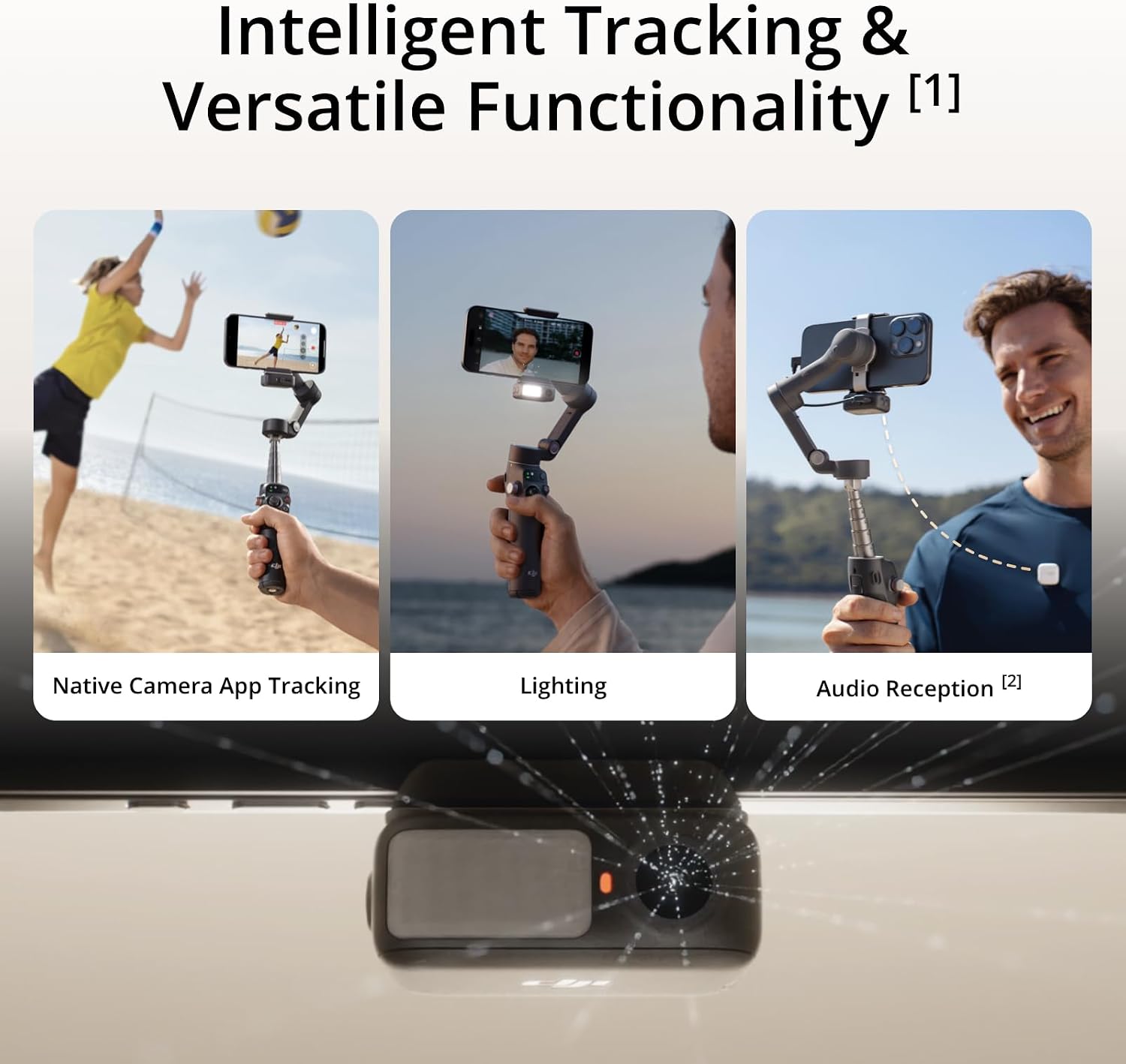
The OM7P ships with a detachable external optical tracking module — a separate sensor that mounts to the gimbal’s base and watches you independent of the phone’s camera. This physical separation is the key unlock for solo creators who need to use the rear main lens. No Film School’s feature “Do You Actually Need a Tracking Module?” explains the core distinction: the module maintains subject lock whether you’re two feet from the camera or twelve, regardless of what the phone’s screen can or cannot see.
DPReview’s hands-on overview of the Osmo Mobile 7P confirms that the optical module draws its own power and communicates wirelessly with the gimbal — which means it needs to be charged, paired, and mounted before your shoot begins. For run-and-gun production, that’s a real preflight checklist item, not a deal-breaker, but it’s genuine friction compared to the one-device simplicity of the base OM7. The module also adds bulk to the folded form factor; it doesn’t collapse away into the gimbal’s profile the way the arm mechanism does.
The tradeoff calculus is direct: if you regularly film yourself using the phone’s rear main camera without a second operator present, the OM7P solves a specific problem that app-based tracking cannot. If you shoot with a partner or work front-camera, you’re carrying hardware you won’t use.
DJI
$99.00
In stock on Amazon
Check price on AmazonThe Osmo Mobile 8 — The Flagship for Heavy Devices and Refined Ergonomics
The OM8 is DJI’s current top-line model in this series. Per DJI’s published product specifications, it ships with a revised motor architecture supporting the higher 360 g payload threshold — 60 g over the OM7 variants. That increment sounds minor until you account for real-world shooting weight: a Samsung Galaxy S25 Ultra weighs approximately 218 g bare, and a standard protective case can bring the total to 260–290 g, approaching the OM7’s ceiling before you’ve added anything else. The OM8’s 360 g limit provides meaningful headroom for large-format Android devices and iPhone Pro Max models running in protective cases.
The OM8 also arrives with refined button placement. Multiple aggregated owner accounts describe the OM7-series button layout as having a learning curve — reviewers use the word “overloaded” to describe multi-function button presses that take a session or two to internalize. The OM8’s physical redesign addresses some of this, though the same reviewers note all three models reach muscle-memory territory within a few outings.
One practical note for buyers considering accessibility: among OM8 owner accounts, a consistent thread describes creators with reduced hand strength, tremor, or mobility constraints who find that the gimbal’s weight distribution and one-handed operation genuinely expands what they can capture compared to handheld-only shooting. The OM8’s ergonomic refinements and balanced grip draw the most positive mentions in this context — a practical data point that equipment roundups rarely surface explicitly.
The OM8 Advanced Tracking Combo bundles the external optical tracking module as an add-on SKU. If you anticipate wanting rear-lens solo tracking capability at the OM8’s payload specs, the Combo is the logical purchase over buying the standard OM8 and the module separately at a later date.
DJI
$125.00
In stock on Amazon
Check price on AmazonApp Dependency: The Friction Point No One Warns About
All three models share this characteristic, so it’s worth addressing directly rather than burying it in a spec table. Basic 3-axis stabilization — the motors keeping your phone level — operates without the DJI Mimo app running. You can clamp your phone into any of the three models, power on, and shoot with your phone’s native camera app and get stable footage. That part requires no app, no account, no pairing beyond the initial Bluetooth handshake.
What requires the app: ActiveTrack subject-following, gesture-trigger controls, timelapse and hyperlapse modes, Story mode templates, and the intelligent shooting modes DJI features prominently in its marketing materials. First-time buyers who open the box expecting to immediately run a tracking shot without setting up Mimo are in for a 10–15 minute onboarding session. Wirecutter’s phone gimbal coverage and the PremiumBeat “Best Phone Gimbals for Video Creators” roundup both note app dependency as a friction point for new users — not because the app is poorly designed, but because the expectation gap between “plug and play” and “app required for smart features” is real.
For practitioners who’ve used any other DJI product: Mimo behaves consistently with the broader DJI ecosystem. The account and pairing workflow will feel familiar if you’ve onboarded to DJI Fly or DJI RC controllers previously.
The Decision Framework: If X, Then Y
Here’s the clean rule set based on DJI’s published specifications, editorial coverage from DPReview, Wirecutter, No Film School, and PremiumBeat, and aggregated owner experience patterns:
If you’re a solo creator and rear-camera quality is non-negotiable for self-filming: The OM7P or OM8 Advanced Tracking Combo is your path. App-based tracking on the base OM7 or standard OM8 does not solve the rear-lens solo problem in most shooting configurations; the optical module does.
If you’re running a large Android device or any iPhone in a heavy protective case: Confirm your phone’s total shooting weight against the 300 g payload ceiling of the OM7 and OM7P before purchasing. The OM8’s 360 g ceiling provides meaningful margin. Exceeding payload is the leading cause of the motor-fighting behavior that generates “defective unit” returns, as Wirecutter’s buyer’s guide explicitly flags.
If the OM7 is available at a meaningful discount: Take it seriously. The stabilization core is the same across all three models, and if app-based tracking serves your workflow, you’re paying for incremental refinements in the higher models that may not surface in your actual output.
If you’re a partner-assisted shooter or always have someone operating the gimbal while you’re on camera: The tracking module is a feature you won’t use. The base OM7 or standard OM8 at its respective price is the right call.
Frequently Asked Questions
Is the DJI Osmo Mobile 7 still worth buying now that the OM8 is out? Yes, with a caveat. If it’s available at a reduced price and your phone falls under 300 g in its shooting configuration, the OM7 delivers the same stabilization quality that wowed reviewers at launch. The OM8’s advantages — higher payload, refined buttons, improved tracking algorithms — are real but incremental for many workflows. Don’t pay full OM7 price when the OM8 is close in cost; do take the OM7 seriously at a genuine discount.
What does the OM7P tracking module actually do that the base OM7 cannot? It provides optical subject tracking independent of the phone’s screen, using a dedicated external sensor. Per No Film School’s “Do You Actually Need a Tracking Module?” feature, this allows the gimbal to follow you while you’re filmed by the rear main camera — a configuration app-based tracking cannot reliably support. For solo creators, it’s the difference between front-camera selfie quality and rear-camera production quality in self-directed shots.
Will the OM7P handle a large phone like the Samsung S25 Ultra? The S25 Ultra weighs approximately 218 g bare. With a standard protective case, total weight can approach 260–280 g — close to the OM7P’s 300 g payload limit. It will likely work, but you’re operating near the ceiling rather than in a comfortable working range. The OM8’s 360 g ceiling provides more margin for large devices in cases.
Do you need the DJI Mimo app to use basic stabilization? No. Physical 3-axis stabilization operates without the app. You do need DJI Mimo to access ActiveTrack, gesture controls, and intelligent shooting modes. Budget 10–15 minutes for initial setup; it’s a one-time onboarding, not a per-session requirement.
What does the OM8 Advanced Tracking Combo include beyond the standard OM8? The Advanced Tracking Combo bundles the external optical tracking module — the same type of sensor included standard with the OM7P — as an add-on to the OM8 base unit. If you anticipate wanting optical tracking at the OM8’s payload specs, the Combo is the logical purchase rather than buying the standard OM8 and the module separately.
Your clearest next step is confirming your phone’s weight in its actual shooting configuration — camera app open, case on, any accessories attached — against the payload ceiling of the model you’re considering. That single number often resolves the comparison before price or features come into play. From there, the tracking module question determines whether you’re a 7P or OM8 Combo buyer versus a base-model buyer. Both answers are correct for the right shooter.