August 12, 2026 • Declan Merritt • 11 min reading time • Prices verified June 17, 2026
Follow Focus Systems Compared: Manual, Wireless, and What Budget Actually Buys You
A follow focus system is the mechanism that lets you pull focus — smoothly shift the sharp zone in your image from one subject or distance to another — without touching the lens barrel itself. On a narrative film set, a dedicated focus puller handles this job with a calibrated wheel and pre-marked focus distances. On a solo or small-crew production, it’s usually you, one hand on the rig, trying not to jog the frame while your subject moves. The goal of any follow focus rig, manual or wireless, is to give you precise, repeatable control over one of the most expressive tools in the image. This article maps the full landscape — from a $25 gear ring to a $400+ wireless motor system — so you can land on the right tool for your actual workflow, not an idealized one.
| EDITOR'S PICKTilta Nucleus Nano II Base Kit… | Mid-tierTilta Pocket Follow Focus | Pre… | Budget pickSmallRig Mini Follow Focus with… | |
|---|---|---|---|
| Type | Wireless | Manual | Manual |
| Control units | Handwheel + motor | — | — |
| A/B stops | — | ✓ | ✓ |
| Rod mount | — | 15mm rod + holder | 15mm rod clamp |
| Max lens diameter | — | — | 114mm |
| Touchscreen | ✓ | — | — |
| Price | $269.10 | $59.00 | $55.99 |
| See on Amazon → | See on Amazon → | See on Amazon → |
The Three Tiers You’re Actually Choosing Between
The follow focus market splits into three honest categories, and the line between them isn’t just price — it’s workflow.
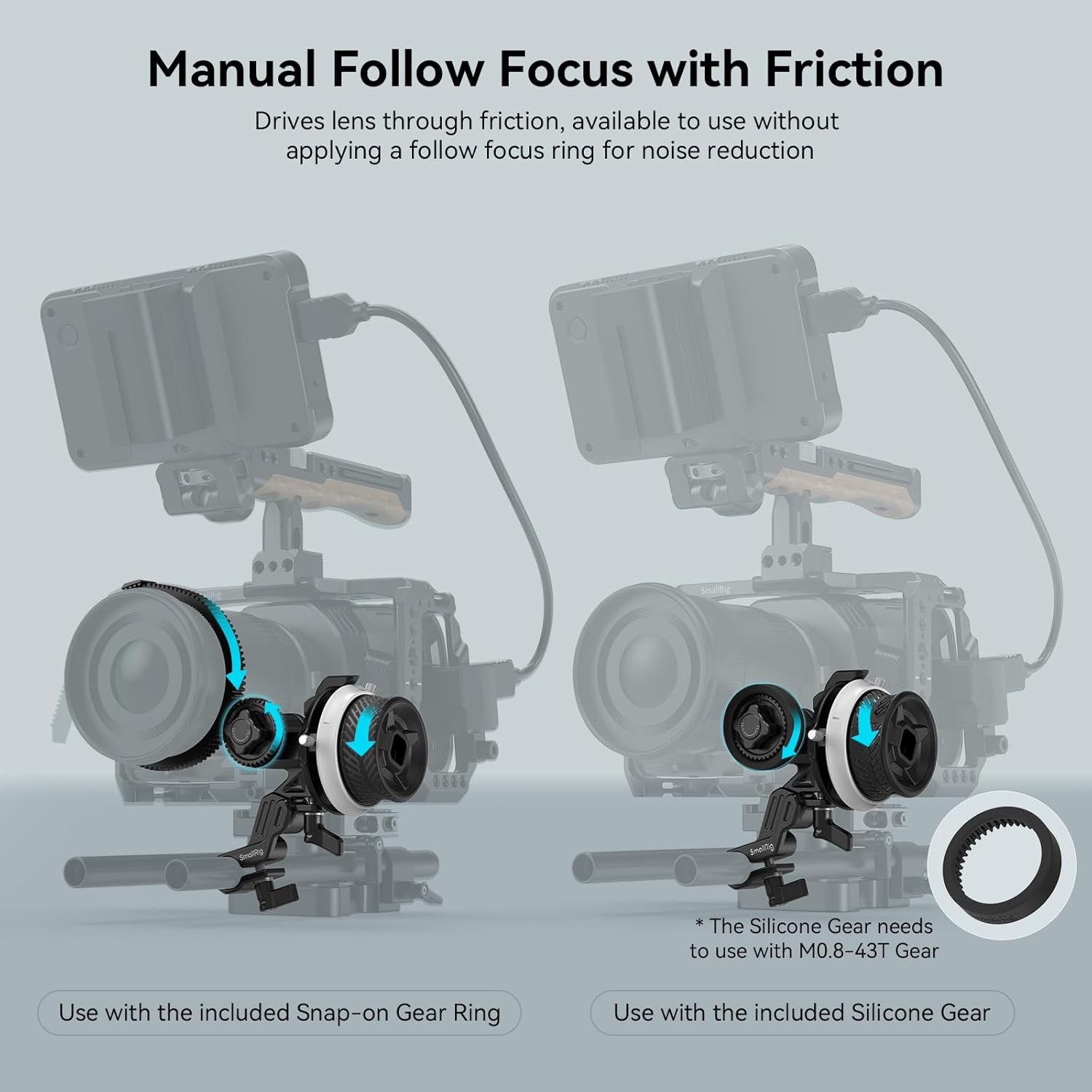
Manual mechanical: A gear ring — a rubberized or hard-tooth ring that clips onto your lens’s focus barrel — pairs with a rod-mounted follow focus unit: a geared wheel and housing that meshes with the ring and translates your hand motion into smooth focus rotation. You physically turn a knob or wheel; a hard stop, if the unit has one, prevents you from overshooting. This is the cinematography equivalent of a manual transmission — more feedback, less lag, more dependence on the operator’s feel.
Wireless motor: A small brushless motor clamps onto your lens barrel or rod-mounted gear ring and is driven by a handheld controller over a radio or Bluetooth signal. You dial focus remotely, which is essential for gimbal shooting, drone work, or any setup where your hands are occupied stabilizing the camera rather than touching it. The tradeoff is a pairing procedure, a battery to charge, and an additional point of potential failure.
Hybrid / lite wireless: Products like the SmallRig Wireless Follow Focus Lite blur the line — a compact wireless system designed to clip onto standard rod setups with minimal calibration and a simplified controller, aimed at solo shooters who want the flexibility of remote control without the full motor system complexity.
No Film School, in their follow focus systems editorial coverage, notes that the single biggest decision factor isn’t budget — it’s whether your camera is on a gimbal. If it is, manual mechanical follow focus is nearly impossible to operate without fighting the gimbal’s stabilization. If your camera is on a tripod, shoulder rig, or slider, manual is often the more reliable choice.
Manual Systems: What You Actually Get at Each Price Point
Gear Rings Alone — Budget Entry
The Neewer gear ring sets are the most searched entry point at this tier. Owners who’ve bought them flag a consistent friction point: fitting a gear ring to your specific lens requires trial and error, and the packaging doesn’t clearly label sizes in a way that maps to common lens filter thread diameters. Plan on buying a set rather than a single ring and expecting to identify the right fit by hand. Reviewers also note they work fine with DJI RS series gimbal focus motors — the teeth mesh correctly — but confirm that ring-to-motor alignment still requires patience to dial in. Don’t expect plug-and-play.
SmallRig
$55.99
In stock on Amazon
Check price on AmazonRod-Mounted Compact Manual Units — Mid Tier
The SmallRig Mini Follow Focus is the most discussed unit in this bracket. The owner feedback pattern is genuinely interesting: multiple reviewers who switched from an electronic motor system report that the manual approach felt simpler and more reliable on static or slider-based setups. The damping feel — how smooth and weighted the resistance is as you turn the wheel — is consistently described as punching above its price. For documentary and run-and-gun work on a tripod or slider, it’s the unit that comes up most often as a pleasant surprise.
The SmallRig F60 is a separate, larger unit worth distinguishing from the Mini. Owners on BMPCC 6K Pro builds specifically call out a rod-placement issue: the F60’s mounting point means the included rods may not physically reach the focus ring on every lens configuration. You need to check your cage’s rod outlet position against your lens’s focus ring position before assuming the included hardware covers your exact setup. It’s not a defect — it’s a geometry problem that any mechanical follow focus can run into — but the F60 surfaces it more often because of the BMPCC’s popular cage configurations.
ProVideoCoalition, in their budget focus control editorial coverage, observes that damping quality is the one spec that never appears on the box but is the first thing operators notice in the field. The SmallRig Mini addresses this more successfully than most units at its price point.
Tilta FF-T07
$59.00
In stock on Amazon
Check price on AmazonShoulder-Rig Manual Units — Upper Manual Tier
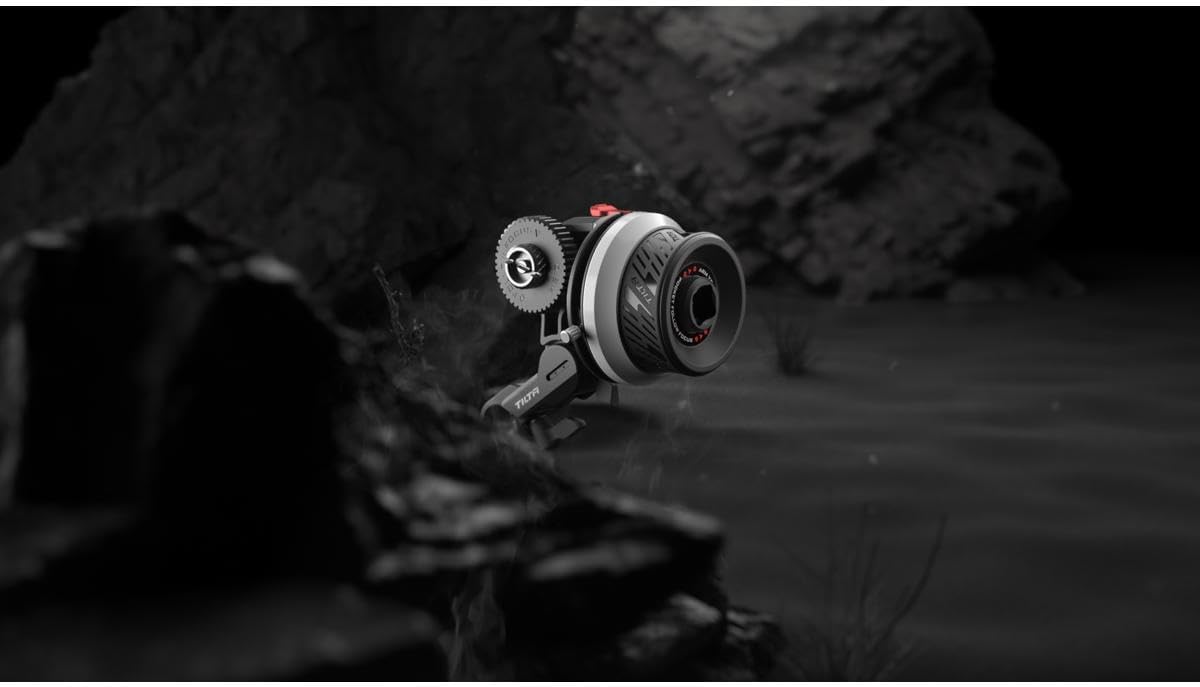
The Tilta Pocket Follow Focus sits above the SmallRig Mini in the damping feel hierarchy. Owners who previously used bundled follow focus units from shoulder rig kits describe the difference as dramatic — smoother actuation, less play in the gear mesh, and markedly better hard stop feel. For operators who spend long shooting days on a shoulder rig and whose hands register every bit of resistance and slop in the focus wheel, this is the unit that justifies the step-up cost.
Tilta
$269.10
In stock on Amazon
Check price on AmazonManual tier at a glance:
| Unit | Rod Standard | Hard Stops | Best For |
|---|---|---|---|
| Neewer Gear Ring Set | N/A (lens mount direct) | No | Gimbal motor teeth matching |
| SmallRig Mini Follow Focus | 15mm / 19mm | Yes | Compact tripod/slider rigs |
| SmallRig F60 | 15mm / 19mm | Yes | Larger builds; verify rod reach |
| Tilta Pocket Follow Focus | 15mm | Yes | Shoulder rigs; damping-sensitive ops |
Most of these units default to 15mm rod systems, which is the dominant standard for mirrorless and DSLR shoulder rigs. 19mm studio rods are thicker and used on heavier cinema camera builds; confirm your rod standard before ordering.
Wireless Systems: Where the Math Changes
Wireless follow focus earns its cost at the exact moment your camera leaves your hands — on a gimbal, on a jib, at the end of a slider run you’re watching through a monitor. Cinema5D, in their wireless follow focus editorial coverage, frames the core value proposition clearly: wireless focus control isn’t primarily about convenience; it’s about creative access to shots that are physically impossible to execute with your hand on the lens.
Wireless Entry — Lite Systems
The SmallRig Wireless Follow Focus Lite is positioned as the approachable entry to wireless — fewer configuration steps, a simplified handset, and a design explicitly aimed at cage-and-rod setups common in mirrorless shooting. Owner feedback is generally positive on ease of setup, though reviewers note it’s genuinely wireless-lite in scope: the controller is minimalist, and if you’re coming from a Tilta or DJI wireless system expecting full parameter control, you’ll feel the constraint. For solo shooters who want the ability to pull focus remotely while the camera is on a small gimbal or slider — and who don’t need deep customization — the Lite earns its position.
SmallRig
$55.99
In stock on Amazon
Check price on AmazonWireless Mid Tier — Motor Systems
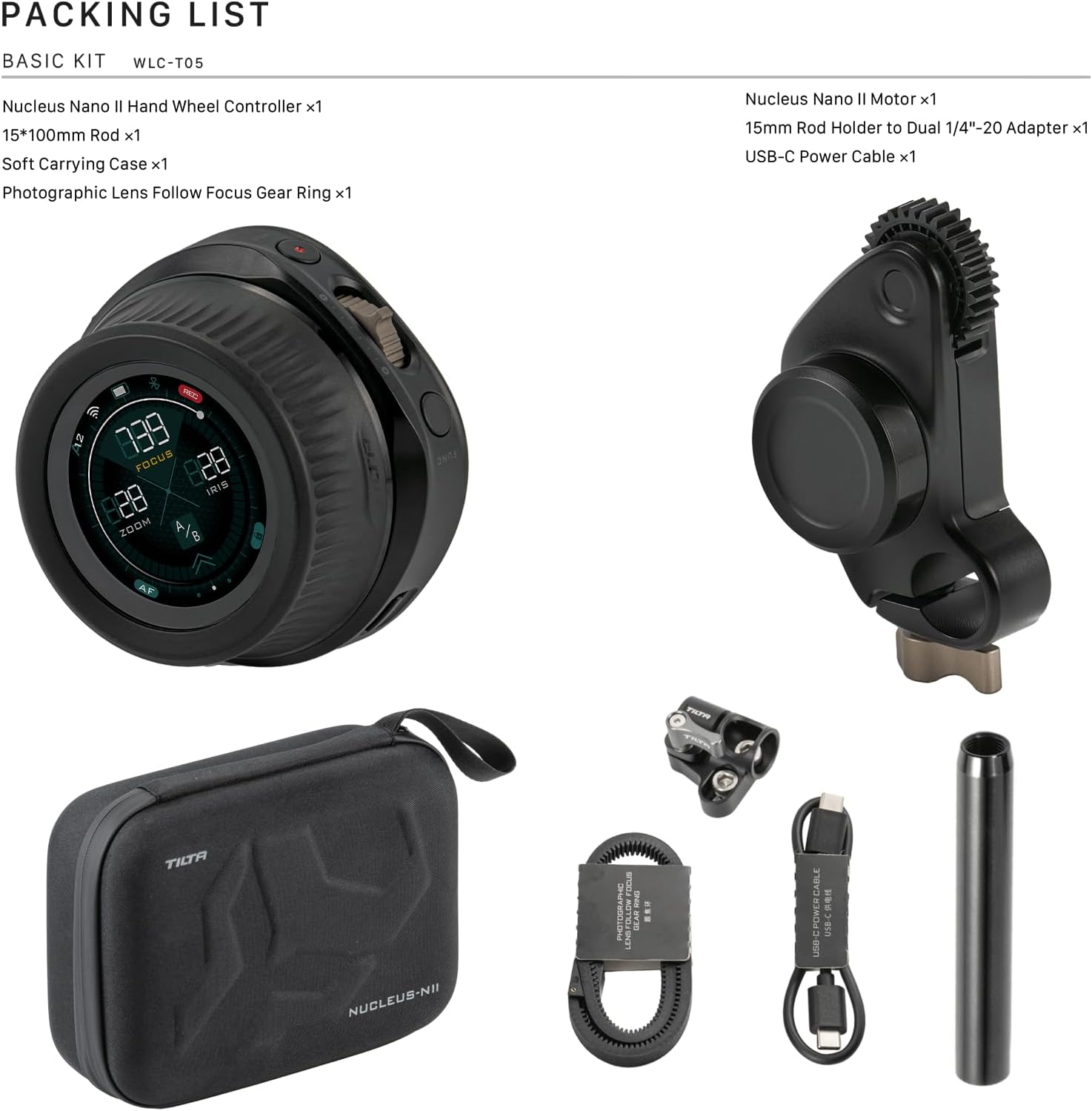
The Tilta Nucleus Nano II is the unit with the most interesting reviewer arc. Early reviews flagged reliability concerns — stalled motors, pairing issues — and some buyers went in skeptical. The pattern in more recent long-form owner reports tells the opposite story: owners report strong motor torque handling stiff legacy glass, specifically older manual-focus lenses where the focus ring hasn’t been used in years and has developed significant resistance.
PremiumBeat, in their camera rigging coverage for indie filmmakers, notes that motor torque spec matters most with vintage adapted lenses, and the Nucleus Nano II’s published torque figures are notably higher than competing units in its price class. The unit’s range and pairing stability on professional shoots get consistent praise, and it appears to have iterated meaningfully across firmware versions. If your workflow involves adapted Contax Zeiss, older Nikkors, or any legacy glass with a tight focus ring, this is the wireless unit to evaluate first.
Tilta FF-T07
$59.00
In stock on Amazon
Check price on AmazonWireless Upper Tier — Cinema-Grade Systems
Full cinema-grade wireless follow focus systems — units from manufacturers at the top of the Tilta Nucleus line and from established cinema accessory brands — represent the ceiling of the market and are outside the scope of this comparison. They are worth naming as the upper bound: if your production regularly employs a dedicated focus puller and works with cinema primes, the economics of a professional wireless system become justifiable. For the indie and prosumer workflows this article addresses, the Nucleus Nano II represents the practical upper bound before diminishing returns set in sharply.
Tilta
$269.10
In stock on Amazon
Check price on AmazonThe Decision Frame: Which Tier Is Actually Right for You
The following if/then logic is drawn from aggregated owner experience and editorial coverage across No Film School, Cinema5D, PremiumBeat, and ProVideoCoalition:
If you’re shooting on a tripod or static slider, solo or with a small crew, and your camera never leaves a rod-based rig: Start with a manual mechanical system. The SmallRig Mini or Tilta Pocket Follow Focus will give you better results than a wireless system you don’t actually need, with no battery dependency or pairing overhead.
If you’re shooting on a gimbal: Manual mechanical is not a viable primary option. A wireless motor system is the functional minimum. Evaluate the Tilta Nucleus Nano II if you’re working with legacy or stiff-ring lenses; evaluate the SmallRig Wireless Follow Focus Lite if you want simplicity and are working with newer mirrorless optics that have lighter focus rings.
If you’re shooting solo in documentary or run-and-gun contexts: The honest answer is that you may not need wireless at all. Solo operators without a dedicated focus puller often find that autofocus on a body and lens that support reliable AF outperforms their own ability to pull focus manually while also operating the camera. No Film School, in their follow focus systems editorial coverage, consistently frames this as the question practitioners underweight: wireless follow focus is most valuable when there’s a dedicated operator for it, or when the camera is physically separated from the operator.
If you’re using adapted legacy glass on any rig: Budget for a system with meaningful motor torque. Cheap motor units stall on stiff rings. The Tilta Nucleus Nano II’s torque headroom is specifically the feature that justifies its cost in this workflow.
On rod diameter: The vast majority of follow focus systems discussed here are designed for 15mm LWS (lightweight studio) rods, the standard for mirrorless and hybrid camera rigs. 19mm rods are an ARRI-standard cinema rig specification. Confirm your baseplate and cage rod standard before ordering any rod-mounted unit.
Frequently Asked Questions
Do Neewer gear rings fit DJI RS 4 gimbal motors? The tooth pitch on Neewer rings is compatible with DJI RS series focus motor teeth, and owners confirm they work together. The persistent issue is sizing — buy a ring set rather than a single ring, and expect hands-on calibration for alignment.
What is the difference between the SmallRig Mini Follow Focus and the SmallRig F60? The Mini is a compact unit designed for smaller mirrorless rigs with a minimalist footprint. The F60 is a larger, heavier-duty unit intended for bigger builds. F60 owners on BMPCC rigs specifically flag a rod-reach geometry issue — verify your cage’s rod outlet position covers your lens’s focus ring before assuming the included rods work for your exact configuration.
Can the Tilta Nucleus Nano II handle older manual lenses with stiff focus rings? Long-form owner reviews say yes, and this is one of the Nano II’s genuine strengths at its price point. Published torque specs are higher than competing units in the same class, and owners specifically report success on adapted legacy glass.
Is the SmallRig Wireless Follow Focus Lite truly plug-and-play with cage-and-rod setups? Relatively, yes — it’s designed for minimal setup on rod rigs and owner feedback supports that framing. It is not a full-featured wireless system, so if you need deep parameter control, look at the Tilta Nucleus lineup instead.
Do I need wireless follow focus if I’m shooting solo? Probably not unless your camera is on a gimbal or physically separated from your hands. For static or slider-based solo shooting, a good manual unit plus reliable autofocus on your body often produces better pulls than attempting remote focus control without a dedicated operator.
What rod diameter do most of these follow focus systems require? 15mm LWS is the dominant standard across all units discussed here. Confirm your baseplate or cage’s rod outlet size before ordering.
Your next step: If you’re on a rod-based rig and shopping manual, the Tilta Pocket Follow Focus represents the clearest quality step-up from entry-level bundled units. If your camera is going on a gimbal, compare the Tilta Nucleus Nano II against your lens inventory’s focus ring stiffness — that torque headroom spec is what will determine whether the price difference is worth it for your glass.