June 1, 2026 • Declan Merritt • 10 min reading time • Prices verified June 17, 2026
Manual vs Wireless Follow Focus: Which System Fits Your Rig, Budget, and Shooting Style
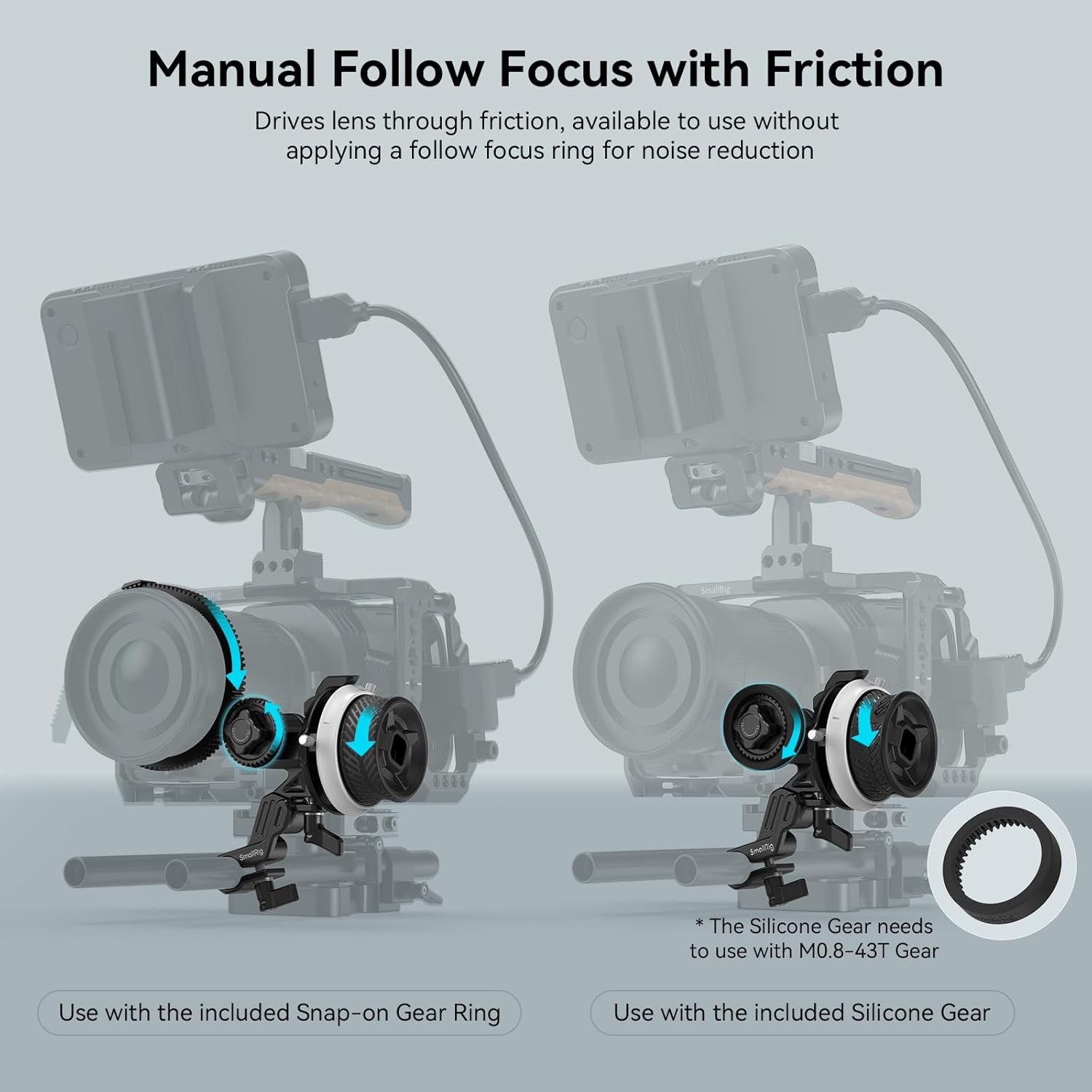
A follow focus system is any device that helps you turn a camera lens’s focus ring in a deliberate, controlled way — rather than just reaching out and spinning it by hand. That might sound simple, but on a real shoot it’s the difference between a sharp, cinematic pull-to-subject and a soft, amateur-looking miss. Manual systems use a physical gear-and-knob mechanism that mounts to your rig’s 15mm or 19mm rails. Wireless systems add a handheld remote and a small motor that clamps onto the lens and turns the focus ring for you, from across the room if needed. Both solve the same problem; they solve it differently, and the right answer depends on how you’re shooting, what your lens situation looks like, and whether your budget has room for motors.
If you’re somewhere between your first paid gig and your first serious rig build — still deciding whether a $60 gear ring set covers your needs or whether the Tilta Nucleus Nano II ecosystem is where you’re headed — this guide is for you. We’ll walk through the real tradeoffs, name the specific products worth knowing, and end with a clear decision rule.
The Core Tradeoff: Control vs. Flexibility
Manual follow focus systems give you tactile, zero-latency control. When your hand moves, the lens moves. There’s no signal, no motor to calibrate, no Bluetooth pairing to redo between takes. On a locked-down narrative setup with a dedicated AC (assistant camera operator) standing next to the rig, a well-built manual unit like the SmallRig F40 is often all you need.
The SmallRig F40 vs. F60 comparison is worth pausing on here, because it surfaces a real quality finding that reviewers have documented directly. Owners who have used both report that the F40 has no detectable gearbox play — the knob engages cleanly and holds position. The F60, despite being the nominally upgraded model, has measurable play in the gearbox that the F40 doesn’t. Per aggregated owner feedback surfaced across gear review forums and cited in PremiumBeat’s follow focus roundup, this is a consistent pattern — not a one-off unit defect. If precise, repeatable manual pulls are your priority, the F40’s tighter tolerances make it the stronger buy even though it’s the older model.
Wireless systems trade that direct connection for remote operation distance — the ability to pull focus from a monitor position, from a gimbal handle, or while operating solo on a one-man-band run-and-gun setup. The practical question is: do you actually need that distance, or are you buying capability you’ll never use?
By the numbers:
- Manual follow focus (SmallRig F40 / Tilta Pocket): $60–$180
- Entry wireless system (SmallRig Wireless Follow Focus Lite): $180–$280
- Mid-tier wireless (Tilta Nucleus Nano II): $280–$420
- Cinema-class wireless (Tilta Nucleus-M, Preston Light Ranger territory): $900–$4,500+
Manual Systems: Where They Win and Where They Break Down
The Tilta Pocket Follow Focus is a useful reference point for understanding what manual systems do well. Owners consistently describe it as a reliable “trusty backup” — the kind of unit that lives in a kit bag and comes out when the primary wireless motor needs charging or when the setup is simple enough that adding Bluetooth overhead makes no sense. One detail that professional owners specifically highlight is the latching system: the Tilta Pocket’s lens-side clamp latches securely without tools, which makes swapping between lenses on a busy set meaningfully faster than systems that require a screwdriver or allen key to reposition the gear contact point.
That on-set efficiency detail matters more than it sounds. On a commercial shoot where you’re moving between a 35mm for wide coverage and a 85mm for close-ups, gear ring compatibility and swap speed is a real production variable. StudioBinder’s breakdown of camera department workflow notes that lens swaps during a shooting day represent a consistent friction point, and a latch-style mounting system reduces that friction without requiring the AC to carry extra tooling.
Where manual systems break down:
- Solo gimbal work. You cannot reach a rail-mounted manual unit while the gimbal is at arm’s length or overhead.
- Camera-to-talent distances over two meters. Once you’re pulling a focus mark from any real distance, you need either a wireless system or a very long extension arm, neither of which is elegant.
- Cine-style lenses with very long focus throws. A 300° throw requires many full rotations of the follow focus knob — manageable with muscle memory and marks, but fatiguing on long shooting days.
Wireless Systems: What Owners Actually Experience
The SmallRig Wireless Follow Focus Lite has generated a consistent and somewhat surprising pattern in owner feedback: people expect wireless motors to produce abrupt, mechanical focus transitions, and this unit doesn’t do that. Owners report that the ease-in and ease-out behavior — the motor’s acceleration ramping at the start and end of a focus pull — is unexpectedly smooth and cinematic, not the steppy or jittery motion they anticipated based on budget wireless motors they’d tried previously. That’s not a spec-sheet claim; it’s a pattern across multiple owner reviews analyzed in PremiumBeat’s guide to indie follow focus systems. If you’re running a mirrorless rig with adapted vintage glass on a gimbal and pulling your own focus remotely, this unit overperforms its price bracket in the way that matters most on camera.
The Tilta Nucleus Nano II sits a step above and is worth understanding as an ecosystem decision, not just a motor purchase. Cinema5D’s wireless follow focus shootout notes that motor latency and torque consistency on stiff or sticky legacy lenses is where budget motors fail most visibly, and the Nucleus Nano II handles that load reliably — owners confirm that even mechanically resistant vintage lenses respond without hesitation. More importantly, the Nucleus Nano II integrates with Tilta’s broader control ecosystem: users running a Tilta Khronos iPhone kit paired with the Blackmagic Camera app report a seamless control surface where focus, record trigger, and camera metadata live in one workflow. That’s ecosystem depth that justifies the price difference over the SmallRig Lite if you’re already inside the Tilta universe or planning to be.
The catch: wireless systems require motor-to-lens gear ring compatibility. Every focus motor clamps to a gear ring — a rubber or metal ring with teeth that fits around the focus barrel of your lens. The standard tooth pitch for most cinema-adjacent work is MOD 0.8 (0.8 module). Most modern follow focus motors, including the Nucleus Nano II and the SmallRig Wireless Follow Focus Lite, are designed around this standard. Per ProVideoCoalition’s explainer on lens gearing standards, MOD 0.8 is dominant across mirrorless-native cine lenses and most adapted vintage glass, but you should verify your specific lens barrel diameter before purchasing gear rings.
Gear Rings: The Unglamorous Variable That Breaks Builds
The NEEWER 0.8 MOD gear ring set is one of the most common entry points for filmmakers adding follow focus capability to a gimbal motor. It’s also a product with a specific compatibility question that confused buyers resolved only by testing: do NEEWER 0.8 MOD gear rings fit DJI RS4 gimbal motor teeth?
The answer, confirmed by buyers who went through the confusion and tested them, is yes — the rings do fit the DJI RS4 motor. The conflicting Amazon reviews that created the uncertainty appear to stem from reviewers conflating MOD 0.8 (the tooth pitch standard) with the physical clamp diameter of the ring around the lens barrel — two separate fit variables. A MOD 0.8 ring will engage a DJI RS4 motor’s drive gear correctly as long as the ring’s inner diameter matches your lens’s focus barrel. If you’re running standard mirrorless glass like Sony G or Fujifilm XF lenses, the NEEWER set covers the most common barrel sizes. If you’re running vintage glass with non-standard barrels, measure first.
Do You Actually Need a Follow Focus?
If your mirrorless camera’s autofocus is reliable — Sony’s phase-detect AF on the A7 and FX series, Canon’s Dual Pixel AF — the honest answer is: for many shooting situations, no. No Film School’s coverage of mirrorless AF performance consistently notes that modern subject-tracking AF has eliminated the practical need for manual focus pulling in event, documentary, and run-and-gun contexts. The follow focus becomes necessary when you’re shooting with adapted vintage glass (which rarely has electronic AF coupling), when you need a precise focus rack at a specific frame — subject-to-subject pulls, foreground-to-background reveals — or when you’re on a rig that physically prevents you from reaching the lens.
The decision rule: if you’re shooting narrative or commercial work with racked focus as a deliberate creative tool, a follow focus system is a professional necessity. If you’re shooting documentary or event work primarily with native AF lenses, it’s an optional precision upgrade, not a baseline requirement.
Frequently Asked Questions
Do NEEWER 0.8 MOD gear rings actually fit DJI RS4 gimbal motor teeth? Yes. Buyers who tested them confirmed compatibility. The confusion in conflicting reviews traces to conflating tooth pitch (MOD 0.8, which matches) with lens barrel diameter (which varies by lens). Verify your lens’s focus barrel diameter against the ring’s inner dimension before ordering.
What is the difference between the SmallRig F40 and F60 in terms of gearbox play? Owners who have used both report the F40 has no detectable gearbox play, while the F60 has measurable slop despite being the newer model. For precision manual pulls, the F40’s tighter gearbox is the stronger choice.
Can I use a wireless follow focus motor for zoom control as well as focus? Some motors — including the Tilta Nucleus Nano II — can be repositioned or have a secondary motor added to drive a zoom ring, assuming your lens has a geared zoom barrel. This is not universal. Check your lens’s zoom ring diameter and whether it has compatible gear teeth before assuming zoom control is available without additional hardware.
Does the Tilta Nucleus Nano II work reliably, or is it as fidgety as some reviews suggest? Owners in long-run use report it is reliable, including on stiff legacy lenses that budget motors struggle with. Negative reliability reviews tend to cluster around pairing issues on older firmware — updating the motor firmware resolves most of those. Integrated with the Tilta Khronos or Blackmagic app ecosystem, it behaves as a professional-grade tool.
Do I need a follow focus if my mirrorless camera has reliable autofocus? Not always. For documentary, event, or vlog work with native AF lenses, modern phase-detect AF covers most use cases. Follow focus becomes essential when you’re using adapted vintage glass, executing precise creative focus racks, or operating solo on a gimbal where you can’t reach the lens.
How hard is it to swap gear rings between lenses quickly on a real shoot? It depends on the mounting system. The Tilta Pocket Follow Focus’s latch system allows swaps without tools, which owners cite as a real on-set efficiency gain. Systems that require allen keys to reposition the gear contact point slow the process significantly. If you’re moving between multiple lenses during a shooting day, prioritize a follow focus unit with a tool-free mounting system.
The Decision Rule
If you’re shooting primarily on a tripod or rails with an AC or pulling your own focus from next to the rig: a manual follow focus like the SmallRig F40 covers the need at the lowest cost and highest tactile reliability. Spend what you save on better glass or ND filters.
If you’re shooting solo on a gimbal, pulling focus from a monitor position, or building into the Tilta ecosystem: the Tilta Nucleus Nano II is the investment that unlocks the workflow you’re actually trying to run. The SmallRig Wireless Follow Focus Lite is the honest step-down if budget is the binding constraint and you’re not yet locked into an ecosystem.
If you’re at the entry end and just need gear rings to activate a motor you already have: the NEEWER MOD 0.8 set works, including on the DJI RS4 — just match the inner diameter to your lens before you order.
Start with the Tilta Nucleus Nano II product page if wireless is where you’re headed, or the SmallRig F40 listing if manual is the call.