May 13, 2026 • Declan Merritt • 10 min reading time • Prices verified June 17, 2026
Motorized Slider Buying Guide: GVM, Neewer, and the Real Tradeoffs at Every Price
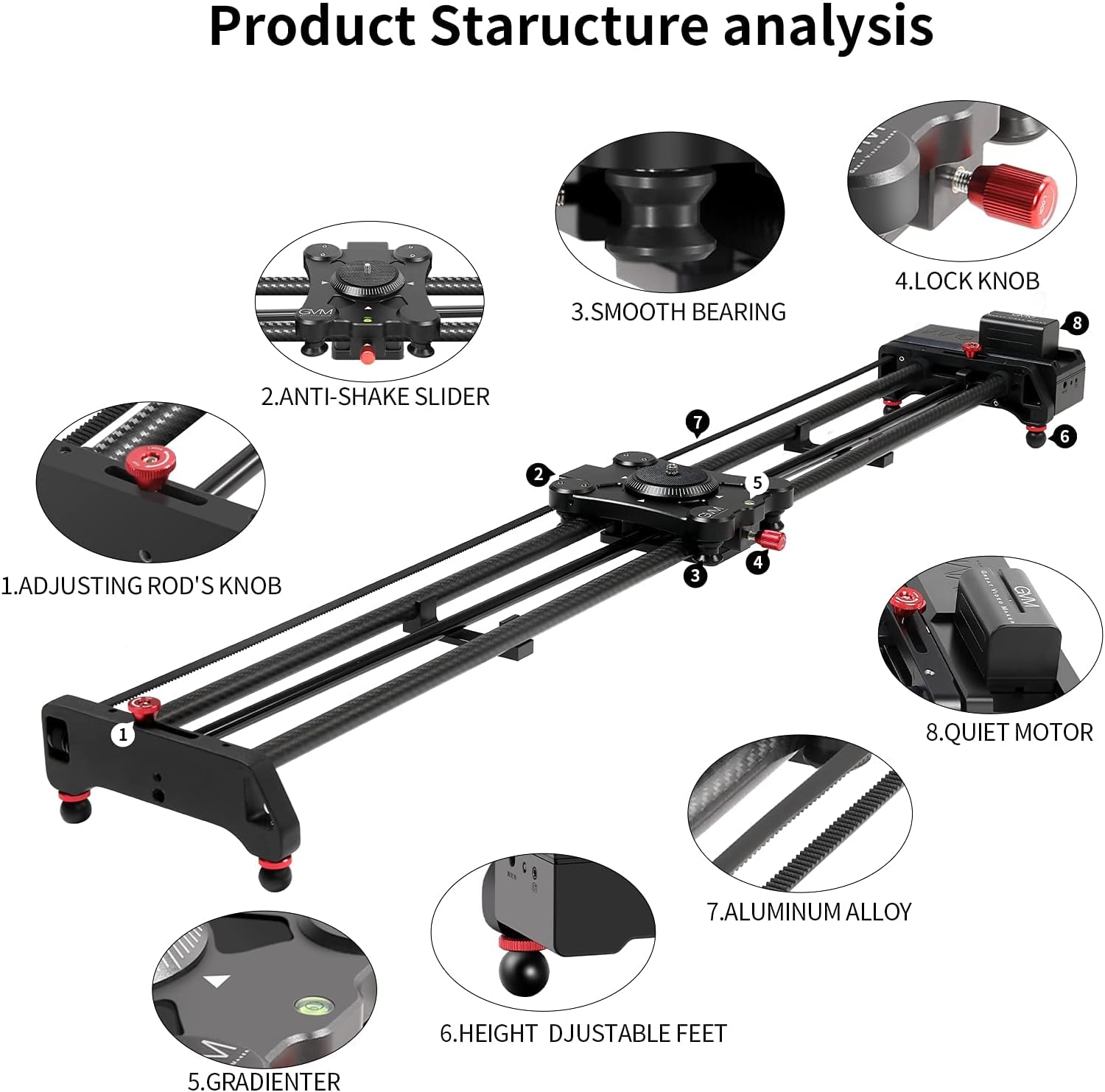
A motorized slider is a camera platform that rolls back and forth on a fixed rail — picture a miniature dolly track you can set on a tabletop or mount across two tripods. The motor drives that movement automatically, so instead of manually pushing a carriage you program speed, distance, and repeat cycles. That repeatability is the whole point: you get smooth, consistent motion passes that would be nearly impossible to replicate by hand, and you can run the same shot over and over for multi-take interviews, product reveals, or time-lapses without touching the camera. The two brands that come up most often in the $200–$600 range are GVM and Neewer, and both have enough of a user base now that real-world patterns have emerged. This guide breaks down what those patterns actually mean for your rig, your workflow, and your budget — so you can stop reading reviews in circles and make a call.
| EDITOR'S PICK[GVM Great Video Maker Camera Mo…](https://www.amazon.com/dp/B09CL2XWY1?tag=greenflower20-20) | Mid-tier[GVM Motorized Camera Slider](https://www.amazon.com/dp/B09B9JFJLV?tag=greenflower20-20) | Budget pick[GVM Camera Slider](https://www.amazon.com/dp/B07M7G7C6T?tag=greenflower20-20) | |
|---|---|---|---|
| Length | 48" | 31" | 27" |
| Material | — | Carbon Fiber | Aluminum Alloy |
| Battery incl. | ✓ | — | — |
| Panorama Mode | ✓ | ✓ | — |
| Price | $269.00 | $239.00 | $179.00 |
| See on Amazon → | See on Amazon → | See on Amazon → |
What You’re Actually Comparing: GVM vs. Neewer at a Glance
Before getting into specifics, it helps to frame where each brand sits. GVM (Great Video Maker) positions its slider line as a build-quality-first option, leaning on aluminum and carbon fiber construction across the 27-inch and 48-inch models. Neewer, a name almost every gear buyer in this space knows from lighting and accessories, brings its DL400 slider into the same conversation with a reputation built on smooth motion control and a clean app interface.
By the numbers — key specs compared:
| GVM 27” | GVM 48” Carbon | Neewer DL400 | |
|---|---|---|---|
| Rail material | Aluminum | Carbon fiber | Aluminum |
| Motor drive | Belt | Belt | Belt |
| Manufacturer payload rating | ~8 kg (17.6 lb) | ~8 kg (17.6 lb) | ~5 kg (11 lb) |
| Remote control | Included physical remote + app | Included physical remote + app | App-only (no physical remote) |
| Power source | NP-F battery | NP-F battery | NP-F battery |
That last column — remote control — is where the real workflow conversation begins.
The Remote Problem (and Why It’s a Bigger Deal Than It Looks)
Across aggregated reviews of the Neewer DL400, a consistent pattern surfaces: owners praise the smoothness of the motion and the quality of the start/stop transitions, but more than one reviewer explicitly calls out the absence of a physical remote as a real limitation on set. When you’re operating solo, an app is fine — your phone sits in your pocket and you trigger moves without touching the camera. But the moment you add a second shooter, a client in the room, or a situation where your phone needs to be doing something else (monitoring, timecode, prompter), app-only control becomes a liability.
GVM owners describe a different experience. The physical remote that ships with the 27” and 48” models gets called out as “absolute crap” in terms of build quality and menu clarity by more than one reviewer — the buttons are cheap, the UI is not intuitive — but the remote exists, and for many operators that physical fallback matters more than the remote’s refinement. The GVM app, separately, gets reasonably good marks from owners who run one-person setups, suggesting the two-track approach (bad physical remote + functional app) covers more scenarios than app-only, even if neither remote is exceptional.
The honest framing from ProVideoCoalition’s motion-control coverage applies here: for controlled studio or interview work, app dependency is manageable. For run-and-gun or documentary-adjacent shooting where you’re changing setups quickly, a physical remote — however imperfect — reduces friction.
Decision rule: If you regularly shoot solo in a controlled environment, the Neewer DL400’s app-only workflow is workable. If you shoot with a crew, or if you frequently switch between monitoring your phone and triggering motion, GVM’s physical remote (imperfect as it is) gives you one fewer point of failure.
Payload Reality: What “8 kg Rated” Actually Means for Your Rig
This is the payload confusion problem that comes up in almost every slider conversation, and it’s worth being explicit. Manufacturer payload ratings are measured under ideal conditions — level surface, centered carriage, no vibration, factory head mount. Your real-world payload is your camera body, plus your lens, plus your cage, plus any follow-focus, monitor, or matte box you’ve attached. That stack adds up faster than most buyers expect.
A practical example: a Sony FX3 body runs about 715g. Add a mid-range zoom lens (say, 500–700g), a SmallRig cage (300g), and a small monitor (250g), and you’re already at roughly 1.8–2 kg before you account for a fluid head or ball head sitting between the camera and the slider carriage. A mid-range fluid head adds another 1–2 kg. You’re now at 3–4 kg on a slider rated for 8 kg — which sounds comfortable until you realize that the rating doesn’t account for the lever-arm effect of an off-center camera or an overhung lens.
Cinema5D’s coverage of motion-control sliders consistently flags this: the practical usable payload on belt-drive sliders in this price range is typically 60–70% of the rated maximum if you want smooth, reliable motor performance over a full shooting day. For the GVM 48” carbon fiber model, owners confirm it handles heavy rigs without the motor struggling — one reviewer specifically notes the 48” running on a single flathead tripod (one tripod supporting one end, the other end resting on a surface or secondary support) with a fully loaded mirrorless setup. That’s a useful real-world data point for operators who don’t always have two tripods available.
The Neewer DL400’s 5 kg rating is more conservative on paper, and owners report that its repeatability and smooth transitions hold up well within that envelope. Where it can show strain is at the upper end of its payload range, particularly with top-heavy rigs.
Decision rule: If your camera + lens + accessories + head consistently lands above 3.5 kg, the GVM 48” carbon fiber gives you more headroom and owner-confirmed heavy-rig performance. If you’re running a lighter mirrorless setup — say, a Sony ZV-E1 or Fujifilm X-S20 with a small prime — the Neewer DL400’s payload envelope is more than adequate, and you gain from its smoother motion profile.
Battery Strategy for a Full Shooting Day
Both the GVM and Neewer DL400 run on NP-F batteries — the same form factor used by countless monitors, LED panels, and other accessories, which makes them easy to source and swap. But a single battery will not carry you through a full production day of continuous motorized use. One reviewer’s workflow note is worth taking at face value: keep three batteries in rotation. One in the slider, one charging, one on standby.
NoFilmSchool’s slider coverage notes that motorized motion adds a consistent power draw that static rigs don’t have — even at low speed settings, the motor is always working. On a day where you’re running time-lapse passes for hours, or doing repeated motion-control takes for a product shoot, battery management becomes an active task rather than an afterthought. Budget for at least two NP-F batteries as part of your initial purchase; three is better if you’re doing full-day commercial work.
The Stability Arms Question: Cross-Sell or Genuine Necessity?
Neewer sells stability arms as an accessory for their slider line, and owners are unusually consistent on this point: they get called “a must-have” across multiple independent reviews, and this pattern extends beyond Neewer-specific setups — operators running other sliders in the same class make the same recommendation. Stability arms are lateral braces that connect the ends of the slider rail to your tripod legs or a baseplate, reducing the flex and micro-vibration that belt-drive systems can introduce when the carriage is in motion.
PremiumBeat’s slider guide frames it well: a slider rail behaves like a bridge — the longer the span and the more weight on the carriage, the more it wants to flex at the midpoint. Stability arms address that deflection. For the GVM 48” model especially, where you’re spanning a meaningful distance, lateral bracing makes a measurable difference in footage smoothness.
You can add stability arms after the fact, but if you know you’re shooting with a heavier rig or doing high-repeat motion passes, factor them into your initial budget. They’re not expensive relative to the slider itself, and the owners who skipped them and came back later consistently say they should have bought them on day one.
Frequently Asked Questions
Can I use a motorized slider on a single tripod or do I need two? Yes — a single tripod works for the shorter 27” models, with the opposite end either unsupported (for tabletop use on a level surface) or rested on a secondary stand. GVM 48” owners confirm single-tripod use with heavy rigs is viable, but two tripods give you level control at both ends and reduce rail flex on longer spans.
What surfaces do motorized sliders work on — can I use them outdoors on uneven ground? Sliders work on any surface where you can level the rail. Outdoors on uneven ground, you’ll need adjustable legs or a ballhead under each tripod to achieve level. The motor doesn’t self-level; if the rail tilts, the carriage speed varies across the pass and footage looks inconsistent. For rough locations, budget time for leveling setup.
Do I need the Neewer stability arms if I already have a sturdy tripod? The stability arms brace the rail laterally — they address rail flex, not tripod stability. A sturdy tripod helps with vibration from the ground up, but doesn’t prevent the rail itself from deflecting under load. If you’re running a rig heavier than about 2 kg or doing repeated passes, the arms earn their cost.
How long do the batteries last on a full shooting day? Expect 2–4 hours of continuous motorized use per NP-F battery, depending on speed settings, load weight, and ambient temperature. For full-day commercial shoots, a three-battery rotation is the owner-recommended baseline.
Does the GVM app work reliably or is it frustrating to use on set? Owner reports are generally positive for solo one-person setups — the app handles speed, distance, and loop settings cleanly. The frustration comes when the phone needs to serve other functions simultaneously (monitoring, client playback), which is where the physical remote matters. The GVM remote’s build quality draws complaints, but having it as a fallback is valued.
What is the real maximum payload I can put on these sliders? A practical working limit of 60–70% of the manufacturer’s rated payload is a reasonable planning figure for smooth, reliable performance over a full shoot. For the GVM models rated at 8 kg, plan your rig around 5–5.5 kg. For the Neewer DL400 rated at 5 kg, plan for 3–3.5 kg.
The Decision Frame
If your rig runs heavy (3.5 kg+), you want the 48” travel range, or you need a physical remote fallback for crew setups — the GVM 48” Carbon Fiber Motorized Slider is the call. The build quality reports are consistently strong, the carbon fiber model handles heavy rigs on a single tripod, and the dual-remote approach (even with a mediocre physical remote) reduces workflow friction.
If you’re running a lighter mirrorless body with a small lens, shooting primarily solo, and prioritize motion smoothness and clean app control over physical remote options — the Neewer DL400 is worth serious consideration. Its start/stop transition quality draws consistent praise, and within its payload envelope it performs above its price point.
Either way, add stability arms to your order and buy at least two NP-F batteries on day one. Those two line items will do more for your real-world results than any spec-sheet comparison.
Browse both models on the GVM and Neewer product pages, and compare the 27” vs. 48” GVM options side by side if rail length is still an open question for your typical shooting scenario.