September 21, 2026 • Declan Merritt • 11 min reading time • Prices verified June 17, 2026
Motorized Slider Support Arms and Stability Fixes: What Owners Actually Do
Motorized Slider Support Arms and Stability Fixes: What Owners Actually Do
A motorized slider is essentially a track-and-carriage system — your camera rides a small platform that rolls or slides along a rail, driven by a motor — mounted on one or two tripods. When it works cleanly, you get those smooth, cinematic dolly moves that would otherwise require a full track-and-cart setup. When it doesn’t, you get footage that wobbles, drifts, or vibrates in a way that no amount of stabilization in post can fully fix. The culprit is almost always the same thing: not enough mechanical support at the rail’s endpoints or midspan. This article is about what owners have actually done to solve that problem — specifically with support arms, which are secondary bracing brackets that connect a slider’s rail to an additional tripod or surface mount — and when those fixes make a real difference versus when they’re overkill.
If you’re running a slider longer than roughly 27 inches with a mirrorless or DSLR body plus any accessories — cage, lens, matte box — you’ve probably already noticed some flex. What follows is a practical breakdown of where the instability comes from, which fixes actually work, and how to make the right call for your specific rig length and shoot type.
| EDITOR'S PICKIFOOTAGE Shark Slider Nano II 6… | Mid-tierGVM Great Video Maker Camera Mo… | Budget pickNeewer Camera Slider Support Ar… | |
|---|---|---|---|
| Payload | 15.4 lbs | — | — |
| Length | 26" | 48" | — |
| Material | — | — | Aluminum alloy |
| Battery included | — | ✓ | — |
| Gimbal compatible | ✓ | — | — |
| Pack count | — | — | 2-pack |
| Price | $699.00 | $269.00 | $80.99 |
| See on Amazon → | See on Amazon → | See on Amazon → |
Why Motorized Sliders Flex (and Why It Gets Worse Over Time)
A slider rail is a lever. The longer the rail, the more mechanical leverage gravity has on the center span — especially when the carriage (and your camera) is positioned anywhere other than directly over a support point. On a standard single-tripod setup, you’re essentially cantilevering weight outward from a single pivot, and that produces a characteristic sag or bounce that becomes more visible as payload increases.
PremiumBeat’s overview of camera slider technique notes that rail flex is one of the most underestimated variables in slider footage quality, and that the problem compounds with motorized systems because the motor’s start-stop torque introduces micro-vibrations that a static, hand-pulled slider wouldn’t generate. No Film School’s slider tips coverage makes the same point: motorized movement amplifies any mechanical slop in the system because the drive mechanism is consistent enough to make irregularities repeatable — meaning they show up in every shot, not just occasionally.
The specific failure modes owners describe break down into three categories:
Flex-induced bounce: The rail bends slightly under load and oscillates when the carriage moves. Most visible on longer rails (40 inches and up) with heavier payloads.
Endpoint sag: Without a second support point, the far end of the rail droops. This creates a gradual tilt change over the length of the move that reads as an unwanted camera drift rather than a programmed move.
Cumulative drift in time-lapse: This one is more subtle. iFootage Nano II owners running multi-hour time-lapse sequences report that even small amounts of mechanical play — barely noticeable in real-time video — compound over hundreds of motor steps into a measurable positional error by the end of a sequence. The slider isn’t drifting in the traditional sense; it’s accumulating tiny mechanical inconsistencies that only become visible at time-lapse playback speed.
What Support Arms Actually Do (and the Improvement Owners Describe)
A support arm is a secondary brace — typically a short articulating or fixed arm — that connects one or both ends of the slider rail to an additional tripod leg or mounting point. The goal is to convert the slider from a single-supported cantilever into a two-point or three-point supported beam, which dramatically reduces midspan flex.
The owner response pattern here is worth paying attention to. Across aggregated Neewer slider reviews, owners who added support arms consistently describe the improvement as immediate and obvious rather than marginal — a characterization that appears repeatedly enough to suggest it’s not a placebo effect. One frequently cited phrase in Neewer support arm reviews is “rock solid,” specifically in the context of longer-rail shots where single-tripod setups had been producing noticeable wobble. That language — “rock solid” versus a vague “better” — suggests the improvement crosses a perceptual threshold rather than just nudging the footage slightly cleaner.
iFootage Nano II owners running extended time-lapse work report that support arms essentially eliminate the cumulative drift problem. The mechanical explanation is straightforward: with two support points, the rail’s geometry is fixed and can’t gradually shift the way a cantilevered beam can under thermal expansion, motor vibration, or minor floor movement.
By the numbers — rail length vs. risk tier:
| Rail Length | Single Tripod Risk | Support Arm Priority |
|---|---|---|
| 24–27 inches | Low (standard payloads) | Optional |
| 31–40 inches | Moderate | Recommended |
| 48 inches+ | High | Essential |
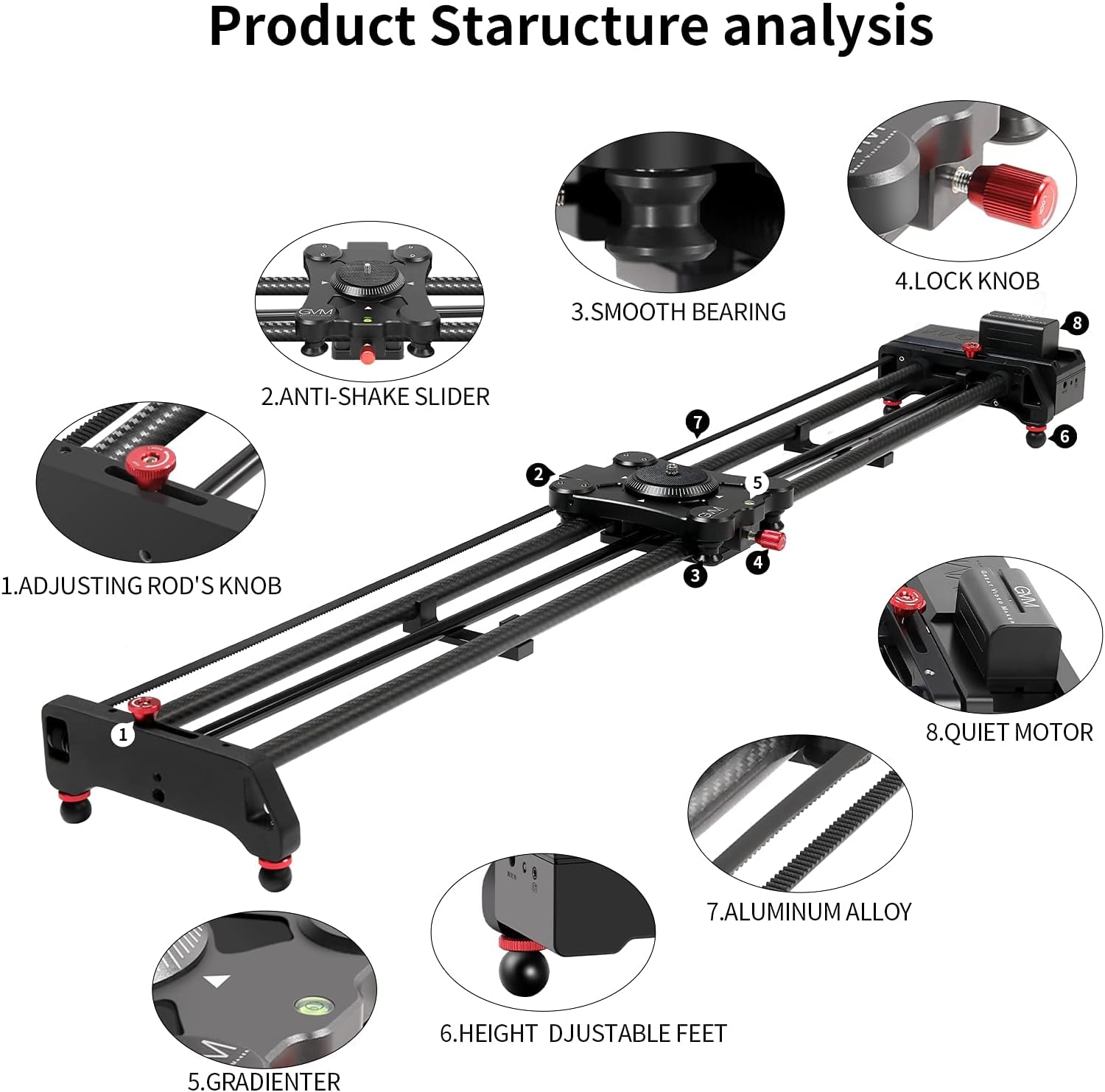
GVM slider owners at the 48-inch length frequently flag stability as the first concern in their reviews. One recurring note in that feedback: a flat-head tripod — meaning a ball-head or flat plate head rather than a bowl head — can technically work as a single support for the 48-inch GVM slider, but reviewers who’ve tried it consistently recommend going “overly sturdy” in their phrasing, which in practice means either a second tripod with support arms or a significantly heavier-duty center tripod than you’d think necessary for the slider’s listed payload.
Cross-Brand Compatibility: Do Neewer Support Arms Work on GVM or iFootage Sliders?
This is one of the most common questions in slider communities, and the answer is mostly yes — with caveats. Neewer’s support arms use standard 1/4”-20 and 3/8”-16 thread interfaces at the mounting points, which are the same thread standards used across virtually all consumer and prosumer slider rails from GVM, iFootage, Zeapon, and similar brands. Cinema5D’s coverage of slider accessories confirms that thread standardization across this product tier makes cross-brand arm mounting generally feasible.
The real variable is rail profile. Some support arm designs use a clamp that wraps around the rail’s extrusion cross-section, and that clamp geometry is rail-specific. If the arm clamps to the rail rather than threading into a bottom-mounted socket, you’ll want to confirm that the clamp opening matches the rail width and profile of your specific slider. Neewer’s arms, based on owner descriptions, use a combination of socket mounting and clamp attachment, which makes them more universally adaptable than arms designed exclusively for a proprietary rail profile.
The practical guidance from owners who’ve done this: measure your rail’s bottom socket thread size and confirm the arm’s clamp inner dimension before assuming compatibility. Most 35mm–45mm width rails will accept the same clamp, but iFootage’s Shark and Nano series use a distinctive carbon-fiber oval profile that occasionally doesn’t seat cleanly in clamps designed for aluminum rectangular extrusions.
The Single Heavy-Duty Tripod Question
Let’s address this directly, because it comes up constantly: can a single heavy-duty tripod — something with a 15 lb or 20 lb rated head — handle a 48-inch slider with a full camera rig?
Technically, yes, in terms of raw payload. The tripod isn’t going to collapse. But payload rating and stability under dynamic load are different things, and this is the distinction that catches people. A head rated for 15 lbs in static vertical load handles that load cleanly when the camera is sitting still. The moment you add a motorized slider with an off-center carriage, you’re introducing a horizontal moment — a rotational force — that the head’s friction or fluid drag has to resist, and that’s a fundamentally different stress than the vertical load it’s rated for.
PremiumBeat’s slider technique overview describes this exact dynamic: the tripod head becomes a torque-resisting element rather than a simple load-bearing one, and heads that aren’t specifically designed for that role (most ball heads, many lighter fluid heads) will allow micro-movement that shows up as footage instability.
The owner-verified solution is two tripods with support arms at both ends of the rail — this effectively removes the tripod head from the torque equation entirely, because the rail is now a supported beam with vertical loads at both ends rather than a cantilevered lever with a single rotational fulcrum.
Leveling on Uneven Floors: The Overlooked Setup Problem
Support arms solve flex and bounce, but they introduce a new setup challenge: getting a two-tripod or three-point rig level on uneven floors. If your two tripods aren’t at identical heights and perfectly co-planar with the rail, you’ll introduce a twist or bow into the rail itself, which creates a tracking anomaly as the carriage traverses a bent rail.
Owners who shoot time-lapse on location — industrial spaces, outdoor concrete, worn studio floors — describe a consistent workflow: level the center tripod first using the ball head, then bring the support arm tripods up to match the rail’s established plane rather than setting them independently. A small torpedo level placed directly on the rail extrusion (not the carriage) is the reference point. The support arm tripods should be adjusted until the rail reads level along its full length, then locked.
Some operators use a laser level as a faster reference when working on floors with significant grade variation. The key principle from owner feedback is sequential rather than simultaneous adjustment — try to level all three points at once and you’ll be chasing your own corrections indefinitely.
Do Support Arms Help Time-Lapse More Than Regular Video?
Both, but for different reasons — and time-lapse may actually benefit more. In regular video, the improvement is perceptual: you eliminate visible wobble and drift within individual clips. In time-lapse, support arms prevent positional drift that accumulates over hundreds or thousands of motor steps, which can translate into a jarring positional jump when the time-lapse is assembled. iFootage Nano II owners specifically call out this use case, describing multi-hour shoots where an unsupported rail had gradually shifted its endpoint position enough to throw off the framing by the end of the sequence.
The Neewer wireless dolly car — a separate floor-rolling carriage system rather than a rail-mounted slider — presents a related but different stability challenge. Owner reviews note it performs cleanly on smooth, hard floors but becomes noticeably less reliable on textured concrete, slightly gritty surfaces, or any floor with minor debris. Unlike rail-bound sliders, the dolly car’s stability is surface-dependent in a way that support arms can’t fix; the fix there is surface preparation rather than rig modification.
Frequently Asked Questions
Do I need support arms for a 27-inch slider or only longer ones?
At 27 inches with a standard mirrorless body and a moderate lens, a single sturdy tripod usually manages without noticeable flex. Owner reports consistently place the threshold closer to 31–36 inches where support becomes genuinely beneficial rather than merely precautionary. That said, if your payload is on the heavier end — a Sony FX3 or Canon C70 with a speed booster and a matte box — adding support even at 27 inches is a reasonable hedge.
Can Neewer slider support arms work with sliders from other brands like GVM or iFootage?
Generally yes, provided you verify that the arm’s clamp opening matches your rail’s profile width. Thread interfaces (1/4”-20 and 3/8”-16) are standardized across the category. The one exception is iFootage’s oval carbon-fiber rail profile, which occasionally needs a different clamp geometry than arms designed for rectangular aluminum extrusions.
Will a single heavy-duty tripod handle a 48-inch slider with a full camera rig?
For payload weight, yes. For stability under motorized movement, usually not without noticeable footage issues. The problem isn’t raw load capacity — it’s torque resistance at the head, which becomes the weak point as the carriage moves off-center. Two tripods with support arms at both rail ends is the owner-proven fix for 48-inch setups.
How do I level a motorized slider when using support arms on uneven floors?
Level the center tripod first, establish the rail’s plane, then bring the support arm tripods up to match — don’t try to level all three points simultaneously. A torpedo level placed directly on the rail extrusion is your reference. Adjust sequentially.
Do support arms help with time-lapse shoots specifically, or only for video?
Both, but time-lapse benefits in a distinct way: support arms prevent cumulative positional drift over multi-hour sequences, not just visible wobble within clips. iFootage Nano II owners running extended time-lapse specifically identify support arms as essential for this reason.
The decision rule: If your rail is 40 inches or longer, or you’re shooting time-lapse for more than 90 minutes on a motorized setup, support arms aren’t an accessory — they’re load-bearing infrastructure. If you’re at 27 inches with a light mirrorless body, a single solid tripod is probably enough, but the moment you add weight or length, the calculus flips fast. Start with the Neewer support arm system as a baseline; it’s what owners in this price tier consistently reach for first, and the cross-brand compatibility makes it a reasonable investment even if you upgrade your slider rail later.