September 7, 2026 • Declan Merritt • 10 min reading time • Prices verified June 17, 2026
Phone Gimbal Features You'll Actually Use — And the Ones That Just Sound Good on the Box
A phone gimbal is a motorized handle that keeps your smartphone camera steady while you move — think of it as a robotic hand that counteracts your shaking, walking, or turning so your footage looks smooth instead of wobbly. If you’ve ever tried to film yourself walking and talking and ended up with something that looks like earthquake footage, a gimbal solves that. The market is crowded right now, and the feature lists on the boxes have gotten genuinely impressive-sounding: “AI tracking,” “ActiveTrack Pro,” “3-axis stabilization,” “built-in ND filter compatibility,” “12-hour battery life.” Some of those features will change how you shoot. Others will never leave the default menu. This guide is built around a simple question: when you’re deciding between the DJI Osmo Mobile 7, 7P, and 8 — or looking sideways at the FeiyuTech SCORP Mini 2 — which features actually justify the price difference, and which are spec-sheet dressing?
If you’re coming in with six months to two years of shooting under your belt, you already know the core stabilization works across all these units. The decision you’re really making is about the surrounding features — tracking intelligence, form factor, payload flexibility, and ecosystem. Let’s build that decision frame clearly.
| EDITOR'S PICKFeiyuTech Official SCORP Mini 2… | Mid-tierDJI Osmo Mobile 7P Gimbal Stabi… | Budget pickDJI Osmo Mobile 7 Gimbal Stabil… | |
|---|---|---|---|
| Battery life | — | 10 hrs | 10 hrs |
| Built-in tripod | — | ✓ | ✓ |
| Extension rod | — | ✓ | — |
| Gesture control | ✓ | — | — |
| Price | $135.88 | $99.00 | $59.00 |
| See on Amazon → | See on Amazon → | See on Amazon → |
The Features That Genuinely Change Your Workflow
AI Subject Tracking — When It’s Real and When It’s Marketing
Across aggregated owner reviews and editorial coverage from Wirecutter and No Film School, AI tracking is the single feature that generates the most polarized feedback — and the polarity is informative.
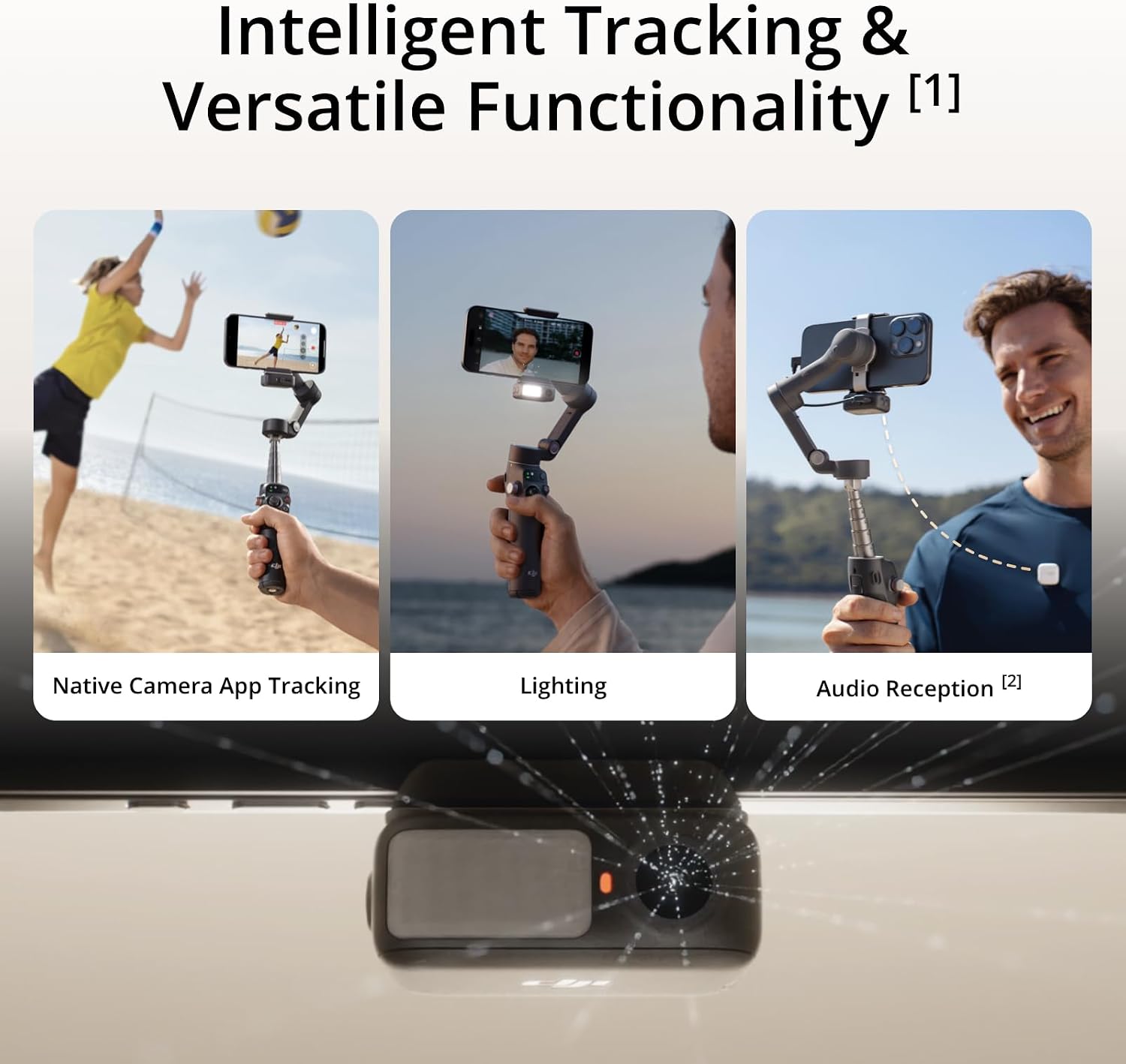
Owners who film fast-moving subjects — dogs, kids, action sports — consistently describe the DJI Osmo Mobile 8’s ActiveTrack 6.0 system as transformative in a way earlier generations weren’t. One recurring pattern in long-run owner reports: the system maintains lock on a moving dog at close range through direction changes in a way that the Osmo Mobile 6 and earlier versions couldn’t sustain. DPReview’s stabilization technology overview notes that the 8’s tracking leverages improved on-device processing that reduces subject-loss events compared to prior generations. If you’re creating content where the subject is unpredictable and the camera operator is also the subject — solo content creators, pet accounts, active lifestyle shooting — this upgrade has practical ROI.
The Osmo Mobile 7’s tracking is meaningfully capable for stationary or slow-moving subjects and controlled environments. If your shooting is mostly vlog-style talking-head content, product showcases, or slow walks, the 7’s tracking is not a limitation you’ll bump into regularly. The No Film School editorial overview of AI tracking on phone gimbals draws a useful distinction: tracking precision matters most when the subject moves faster than a walking pace or changes direction frequently. Below that threshold, the generational delta between the 7 and 8 is smaller than the price difference suggests.
Stabilization as Accessibility — A Real Use Case
One under-discussed dimension of gimbal stabilization is its function as an assistive tool. Owners with hand tremor conditions — whether from essential tremor, Parkinson’s, or other motor conditions — have documented, in first-person reviews, that the Osmo Mobile 8’s stabilization compensates for involuntary movement in ways that make filming viable when it otherwise wouldn’t be. This isn’t a niche marketing angle; it’s a real functional outcome that broader stabilization coverage rarely addresses. If this is relevant to your situation or someone you’re advising, it belongs in the decision frame.
The Built-In Extension Rod and Tripod (Osmo Mobile 7P): Actually Useful, With Caveats
The 7P’s most-discussed differentiator over the base 7 is the integrated extension rod and fold-out tripod legs. Owners consistently describe this as genuinely replacing a separate tabletop tripod for run-and-gun solo work — it’s not a gimmick in the hands of someone who shoots without a crew. The PremiumBeat phone gimbal buyer’s guide flags integrated tripod legs as one of the higher-value structural features in the sub-$200 category because it eliminates a friction point: you don’t need to find a surface, pull out a separate stand, and reconnect.
The honest caveat: the integrated tripod is stable on flat surfaces for stationary shots, but it’s not a substitute for a dedicated tabletop tripod if you’re doing longer takes where wind, vibration, or uneven surfaces are factors. Treat it as a convenience multiplier for solo shooting, not a full equipment replacement.
The Numbers That Actually Determine Your Decision
| Model | Tracking Generation | Integrated Stand | Approx. Battery (Active) | Relative Price Tier |
|---|---|---|---|---|
| DJI Osmo Mobile 7 | ActiveTrack 5.0 | No | ~8 hrs (light use) | Entry |
| DJI Osmo Mobile 7P | ActiveTrack 5.0 | Yes (rod + tripod) | ~8 hrs (light use) | Entry+ |
| DJI Osmo Mobile 8 | ActiveTrack 6.0 | No | ~6–7 hrs (active tracking) | Mid |
| FeiyuTech SCORP Mini 2 | AI tracking (Feiyu) | No | ~8 hrs (rated) | Entry-Mid |
Battery note: the Osmo Mobile 8 runs shorter than its predecessors under active tracking load, not longer — a tradeoff owners consistently flag. If you’re shooting all-day events without reliable charging access, that’s a real operational consideration the spec sheet buries.
The Features That Sound Good and Mostly Stay in the Menu
Multiple Shooting Modes Nobody Toggles
Virtually every phone gimbal now ships with eight to twelve named shooting modes: Inception mode, FPV mode, Spin Shot, Flashlight mode, and so on. PremiumBeat’s buyer’s guide and Wirecutter’s aggregated owner data both point to the same pattern: most owners regularly use two or three modes — standard stabilized, subject tracking, and occasionally selfie mode. The rest are discoverable-once, forgotten-quickly features that don’t affect purchase decisions unless a specific use case is driving your search.
If you see “12 shooting modes” on a box and no other differentiators, treat it as noise. If you see a specific mode that maps to a specific workflow you already do — timelapse, for instance — verify that mode exists and works well before pricing it in.
Bluetooth Range Specs
Every gimbal in this tier advertises Bluetooth range that exceeds practical solo shooting distances. If you’re within 30 feet of your phone, which describes almost every solo content creator scenario, Bluetooth range is not a differentiable feature. Don’t let it occupy mental real estate.
The FeiyuTech SCORP Mini 2: Where the Polarization Comes From
The SCORP Mini 2 sits at a 3.7-star aggregate — which, in a market where good gimbals tend to cluster at 4.3 and above, signals real polarization rather than mediocre consensus. Understanding the split is more useful than averaging it.
Enthusiastic owners consistently cite the form factor (compact folded footprint) and the AI tracking responsiveness as genuine strengths for content creators who want a pocketable option with smart features. If the SCORP Mini 2 were marketed purely as a phone gimbal, the satisfied owners would likely outnumber the dissatisfied ones.
The problem — and this is a payload and positioning problem — is that the SCORP Mini 2’s product page and some retailer listings position it as capable of handling both a phone and a small mirrorless camera. One documented one-star review pattern: users mounting a Sony A7 III to the SCORP Mini 2 and receiving an overload error within 20 minutes of use. This isn’t a surprise if you read the payload spec carefully — the A7 III body alone, before a lens, approaches or exceeds the SCORP Mini 2’s design envelope. The FeiyuTech official documentation specifies payload limits that a full-frame mirrorless system with glass will breach. This is a textbook payload confusion failure: the product’s own positioning creates an expectation the hardware can’t sustain.
The decision rule here is blunt: if you’re pairing this with a phone, the SCORP Mini 2 is a legitimate contender at its price point. If you’re pairing it with a Sony A7 III or any full-frame body, you’re in the wrong product category — look at dedicated camera gimbals with payload specs rated for your body-plus-lens combination.
The Osmo Mobile 7 as a Value Decision (Not a Compromise)
The pattern in Osmo Mobile 7 owner reviews is specific enough to be instructive: buyers who chose the 7 over the 8 consistently frame it as a deliberate value decision rather than a reluctant compromise. “Prior generation at half the price” is a recurring self-description, and the satisfaction rate in long-run reviews reflects that framing — owners who price-shopped intentionally are not disappointed by the tracking delta because they priced it in.
This matters for your decision frame. The 7 is not a worse product for most phone-first workflows. It’s a different value proposition. If your primary subject is a person moving at walking speed or slower, if you’re not shooting fast-moving animals or sports, and if you want to minimize ecosystem spend — the 7 is the honest answer.
Frequently Asked Questions
Do you need the DJI app to use the Osmo Mobile 7 or 7P? The Mimo app (DJI’s companion application) unlocks the full feature set — AI tracking, shooting modes, and firmware updates. The gimbal functions as basic motorized stabilization without the app, but the features that differentiate it from a manual stabilizer require the app. For practical purposes, assume the app is part of the product.
What is the practical difference between the Osmo Mobile 7 and the 7P beyond price? The 7P adds an integrated extension rod and fold-out tripod legs. The tracking system and stabilization hardware are otherwise equivalent. If you regularly shoot solo without a crew and would otherwise carry a tabletop tripod, the 7P’s integrated stand has real utility. If you always have a surface or a separate tripod, the base 7 reaches the same stabilization outcomes.
Can the DJI Osmo Mobile 8 track fast-moving subjects like pets or children reliably? Based on aggregated owner reports, the Osmo Mobile 8’s ActiveTrack 6.0 handles fast-moving, direction-changing subjects — including dogs at close range — better than prior generations. It’s not flawless in all lighting conditions, and subject loss can still occur in cluttered backgrounds, but the improvement over the 6 and 7 is consistent across long-run owner documentation.
Will the FeiyuTech SCORP Mini 2 work with a Sony A7 III mirrorless camera? Based on FeiyuTech’s published payload specifications, the A7 III exceeds the SCORP Mini 2’s design envelope once a lens is mounted. Owner reports of overload errors within minutes of use confirm this in practice. The SCORP Mini 2 is a phone gimbal. For a Sony A7 III, you need a camera-class gimbal with a payload spec that covers your body-plus-lens combination.
Does the Osmo Mobile 7P’s built-in tripod actually replace a separate tabletop tripod? For flat-surface, short-duration stationary shots in controlled environments — yes, it functionally replaces a tabletop tripod for solo run-and-gun work. For longer takes, windy conditions, or uneven surfaces, a dedicated tripod remains more stable. Treat the built-in legs as a convenience upgrade, not a full equipment substitute.
How long does the battery last on the DJI Osmo Mobile 8 during active tracking sessions? Owner reports put real-world active tracking battery life at approximately six to seven hours — notably shorter than the Osmo Mobile 7’s approximately eight hours under comparable load. The 8’s improved processing draws more power. For all-day event shoots without charging access, this is a meaningful operational variable to plan around.
The decision rule in plain language: If your subject moves fast and unpredictably — pets, kids, action — the Osmo Mobile 8’s tracking upgrade is worth the step up. If your workflow is controlled and subject-speed is moderate, the Osmo Mobile 7 or 7P reaches the same functional outcome at a meaningfully lower cost, and the 7P’s integrated stand earns its price difference if you shoot solo regularly. The FeiyuTech SCORP Mini 2 is a legitimate phone-only option with a real form-factor advantage — but verify your payload before buying, and don’t let dual-camera positioning language create expectations the hardware can’t meet.
Your next step: compare the DJI Osmo Mobile 7, 7P, and 8 side-by-side on current specifications and pricing to confirm which tracking tier and form factor match your specific shooting context.