September 28, 2026 • Declan Merritt • 10 min reading time • Prices verified June 17, 2026
Quick Release Plate Ecosystems Explained: Arca Swiss, HawkLock, Manfrotto RC2, and Universal Plates
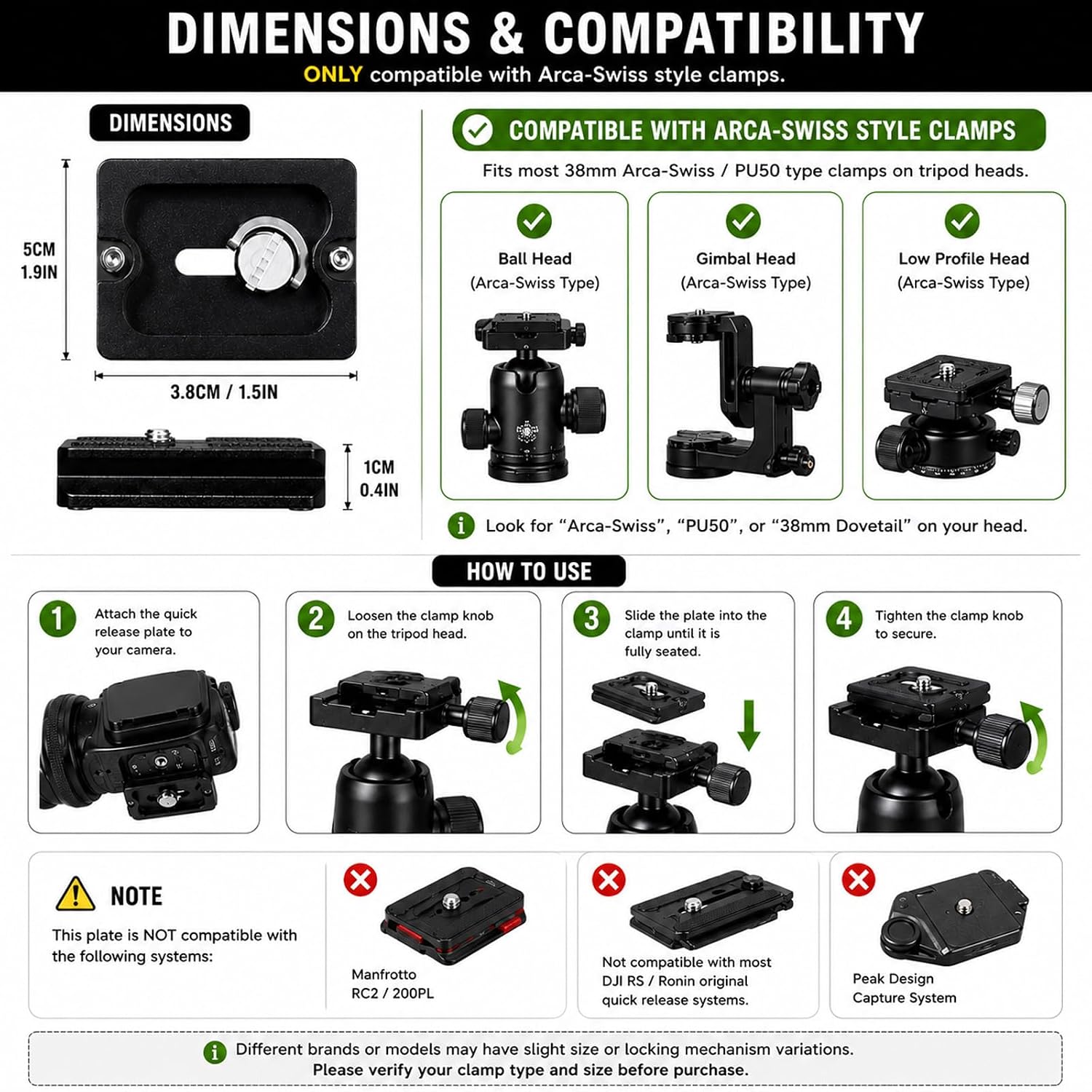
A quick release plate is the small metal sled that mounts to the bottom of your camera, so you can click the camera onto a tripod head — or pop it off — without unscrewing anything. The clamp is the jaw on the tripod head that grips the plate. Together they form a quick release system, and that word “system” is doing a lot of work: the plate and the clamp have to be designed for each other, or the camera either won’t lock in, won’t release cleanly, or — worst case — wobbles under load. The problem is that four competing plate standards exist right now, they look superficially similar, and manufacturers don’t always warn you when their products won’t mate with the competition. This guide maps out the landscape clearly, names the tradeoffs, and gives you a decision rule you can apply before you’re standing in a rental house or unboxing gear the night before a shoot.
| EDITOR'S PICKULANZI F38 Multi-Hole Camera Qu… | Mid-tierUTEBIT 323 RC2 Tripod Quick Rel… | Budget pickFrienda 2 Pieces Metal Quick Re… | |
|---|---|---|---|
| Mount type | F38 QR | 323 RC2 | PU50 |
| Screw thread | 1/4" to 3/8" | 1/4" and 3/8" | 1/4"-20 |
| Plate count | — | — | 2 |
| Material | — | Metal | Metal |
| Manfrotto fit | — | ✓ | — |
| Price | $28.89 | $15.99 | $9.99 |
| See on Amazon → | See on Amazon → | See on Amazon → |
The Four Systems at a Glance
Arca Swiss — The De Facto Standard
Arca Swiss (often written “Arca-Swiss”) is not a single manufacturer; it’s a dovetail rail geometry that has become the closest thing the industry has to an open standard. The plate has a beveled, trapezoidal cross-section — typically 38mm wide — and slides into a matching dovetail clamp that tightens with a thumbscrew or lever. Because the specification isn’t formally patented in a way that limits third-party production, dozens of manufacturers make Arca-compatible plates and clamps: RRS (Really Right Stuff), Sunwayfoto, Kirk, Peak Design, PGYTECH, Ulanzi, SmallRig, and many others all produce Arca-footprint gear.
The practical consequence is a large, mostly-interoperable ecosystem. “Mostly” is doing critical work there, and we’ll come back to it.
Where it wins: Maximum cross-brand interoperability. If your ball head, fluid head, slider, and monopod clamp are all Arca Swiss, one plate family covers everything. Reviewers at B&H Photo Video’s quick release guide consistently describe this as the primary reason professionals converge on Arca over time.
Where it bites you: “Arca compatible” is not a guarantee. Clamp jaw width, safety stop placement, and rail length tolerances vary enough between budget manufacturers that some plate-and-clamp combinations produce lateral slop under heavy telephoto loads. Premium Arca plates from RRS or Kirk are machined tighter; budget plates can introduce wobble on premium clamps, and vice versa.
Manfrotto RC2 — The Proprietary Island
RC2 is Manfrotto’s in-house quick release system: a rectangular, flat plate with a locating pin that drops into a dedicated Manfrotto RC2-style head. The geometry is completely different from Arca Swiss. An RC2 plate will not engage in an Arca clamp — the plate is flat where an Arca clamp expects a dovetail bevel, so the clamp jaw has nothing to bite.
This is the single most common compatibility mistake documented in owner reviews across aggregated retail feedback, per Premium Beat’s camera support buyer’s guide. Buyers who purchase an RC2-equipped Manfrotto head and later add an Arca ball head to the same kit discover the incompatibility only when they try to swap. The fix is either a dedicated RC2-to-Arca adapter plate (they exist, they add height and weight) or committing to separate plates per head.
Where it wins: RC2 is a mature, reliable system with a large install base. If your whole kit is Manfrotto — tripod, video head, monopod — RC2 is seamless, and the plate cost per unit is low.
Where it bites you: The moment you add any non-Manfrotto clamp to your workflow, you’re managing two separate plate inventories. UTEBIT’s RC2-compatible plates receive consistent praise for rapid tripod-to-gimbal swaps in owner reviews — but that workflow collapses the instant an Arca clamp enters the chain. If you’re mixing brands at all, this is the system that creates the most friction.
SmallRig HawkLock — Lever Action for Speed
HawkLock is SmallRig’s proprietary lever-release system. Rather than a thumbscrew, a side lever clamps and releases the plate in a single flip motion. The plate footprint is Arca-compatible in width, but the lever clamp mechanism is SmallRig-specific — non-HawkLock clamps won’t replicate the lever action even if the plate physically seats.
Owner reviews of the SmallRig HawkLock Mini specifically highlight security under telephoto loads. One documented owner account describes confidently running a 150–600mm zoom on a monopod with a HawkLock mini clamp, crediting the lever’s positive engagement for eliminating the micro-wobble that thumbscrew Arca clamps can produce when not fully tightened. That’s a meaningful real-world data point: lever closure removes operator error from the tightening step.
Where it wins: Speed and consistency of lock. On run-and-gun or event work where you’re mounting and dismounting repeatedly, lever action is faster than threading a thumbscrew under pressure. The system also punches above its weight class for telephoto monopod use, per the pattern in aggregated owner feedback cited at Cinema5D.
Where it bites you: You’re buying into SmallRig’s clamp ecosystem. The plates will physically fit Arca clamps for static positioning, but you lose the lever benefit — and the HawkLock’s safety-lock geometry means some third-party Arca clamps won’t release the plate cleanly. Test before committing.
PGYTECH V2 and Universal Plates — The “Set It and Forget It” Middle Ground
PGYTECH’s V2 quick release system occupies an interesting position: it uses an Arca-compatible dovetail plate but adds a secondary locking lever and a wider clamp base that accepts both its own plates and most standard Arca plates. Owners consistently describe a “set it and forget it” deployment pattern — multiple reviewers across retail platforms report buying two, three, or even four V2 clamp units to outfit every support surface in their kit (tripod, mini tripod, slider, gimbal) so any plate slides anywhere without thought.
The Ulanzi F38, another entry in the “universal plate” category, earns specific praise for an unusually smooth lock mechanism at its price point. Reviewers note the F38 is physically smaller than product photography implies — a detail that matters if you’re spec’ing a cage build and need to account for plate height. It’s worth measuring against your cage’s bottom plate before ordering.
By the numbers — Arca Swiss plate width tolerance across tiers:
| Tier | Typical rail width | Jaw tolerance | Real-world slop risk |
|---|---|---|---|
| Premium (RRS, Kirk) | 38.0mm ± 0.1mm | Tight | Minimal |
| Mid (PGYTECH V2, Sunwayfoto) | 38.0mm ± 0.3mm | Good | Low |
| Budget (generic “Arca compatible”) | 37.5–38.5mm variable | Loose | Moderate–High |
Sources: Published spec comparisons aggregated at DPReview’s Arca Swiss compatibility discussion thread and B&H Photo Video product spec sheets.
The Ecosystem Lock-In Tax
Here’s the decision frame most buyers skip: every quick release system has an exit cost. If you buy six RC2 plates for six camera bodies and decide to migrate to Arca, those plates are either adaptered (added height, added weight, added failure point) or replaced. At $15–30 per plate, six bodies is a $90–$180 write-off — not catastrophic, but a real number. At the cinema end of the market, L-brackets and body-specific plates from RRS or Kirk run $80–200 each. Migrating a five-camera operation away from one Arca-adjacent system to another isn’t free.
The practical rule: commit to one plate family, then equip every clamp in your kit to match. The PGYTECH V2’s cross-compatibility with standard Arca plates makes it the lowest-friction on-ramp if you’re mid-migration or building a kit from scratch. The HawkLock is the right call if speed and heavy-load security matter more than universal compatibility. RC2 stays viable only if your entire head inventory is Manfrotto and you have no plans to add Arca ball heads, sliders, or gimbal adapters.
No Film School’s tripod and quick release primer makes the same point plainly: the biggest support-gear regret among working operators isn’t buying the wrong head — it’s building a mixed-standard plate inventory and then spending shoots managing the inconsistency rather than the shot.
Frequently Asked Questions
Are Manfrotto RC2 plates compatible with Arca Swiss clamps without an adapter?
No. RC2 plates are flat-bottomed with a locating pin; Arca Swiss clamps require a beveled dovetail profile to grip. An RC2 plate dropped into an Arca clamp will not lock — the jaw has no geometry to engage. You need either an RC2-specific head or a dedicated adapter plate.
Can I use SmallRig HawkLock plates on a non-SmallRig tripod?
The HawkLock plate’s dovetail profile is Arca-compatible in width, so it will physically seat in most Arca clamps. However, you lose the lever-action lock — you’re operating it as a standard Arca plate. Some Arca clamps with deep safety stops may not release a HawkLock plate cleanly due to the plate’s locking geometry. Confirm fit before relying on it in the field.
Is the PGYTECH V2 clamp compatible with all Arca Swiss plates or only PGYTECH plates?
The V2 clamp accepts standard 38mm Arca Swiss dovetail plates from most brands, not just PGYTECH’s own plates. Owners report using RRS, Sunwayfoto, and generic Arca plates in V2 clamps without issue. Very narrow or very wide Arca-adjacent plates (outside the 37–39mm range) may not seat securely — check the plate width against PGYTECH’s published clamp spec before mixing.
How much weight can these quick release systems safely hold — and do the ratings match real-world use?
Manufacturer ratings are typically conservative and assume centered loads on a static surface. Owners using HawkLock systems under 150–600mm telephoto lenses on monopods — a cantilevered load well beyond static tabletop conditions — report solid performance. Budget Arca clamps with loose jaw tolerances are where real-world performance diverges most from rated capacity: the clamp may be rated for 8kg but introduce visible wobble at 4kg if the plate-to-clamp fit is sloppy. Premium machined plates (RRS, Kirk) consistently close this gap per the aggregated pattern in DPReview compatibility discussions.
What happens if I mix Arca Swiss plates and clamps from different brands — is there wobble?
Sometimes yes, sometimes no — it depends on manufacturing tolerance. Premium plates in premium clamps: no detectable wobble. Budget plates in premium clamps: often fine. Budget clamps with any plate: the most variable outcome. The table above gives the practical tolerance picture. If you’re shooting handheld-to-tripod transitions on a slider or crane where micro-movement is visible on long lenses, invest in matched premium plate-and-clamp combinations from the same manufacturer or from established Arca-spec brands.
If X, Then Y — Your Decision Rule
- If your entire head inventory is Manfrotto and you’re not adding Arca gear: stay on RC2. It’s a solved problem inside its own ecosystem.
- If you’re building or expanding a multi-head kit and want maximum flexibility: standardize on Arca Swiss. Start with PGYTECH V2 clamps for budget-conscious interoperability, or RRS/Sunwayfoto for precision-critical setups.
- If you’re a run-and-gun or telephoto shooter and speed of mount matters more than cross-brand compatibility: SmallRig HawkLock is the system owners keep returning to for lever-speed and heavy-load confidence.
- If you’re mid-migration and need a bridge: the PGYTECH V2’s cross-compatibility with standard Arca plates lets you transition heads one at a time without replacing all plates simultaneously.
The next step: identify every clamp currently in your kit — tripod head, ball head, monopod, slider, gimbal adapter — write down their plate standard, and count how many different standards you’re managing. If the answer is more than one, the cost of that mismatch compounds every time you’re on a tight turnaround. Pick a standard, equip every clamp to match, and eliminate the variable.