May 25, 2026 • Declan Merritt • 10 min reading time • Prices verified June 17, 2026
Vest and Arm Stabilizer Systems for Gimbal Users: What Budget Rigs Cost You Beyond the Price Tag
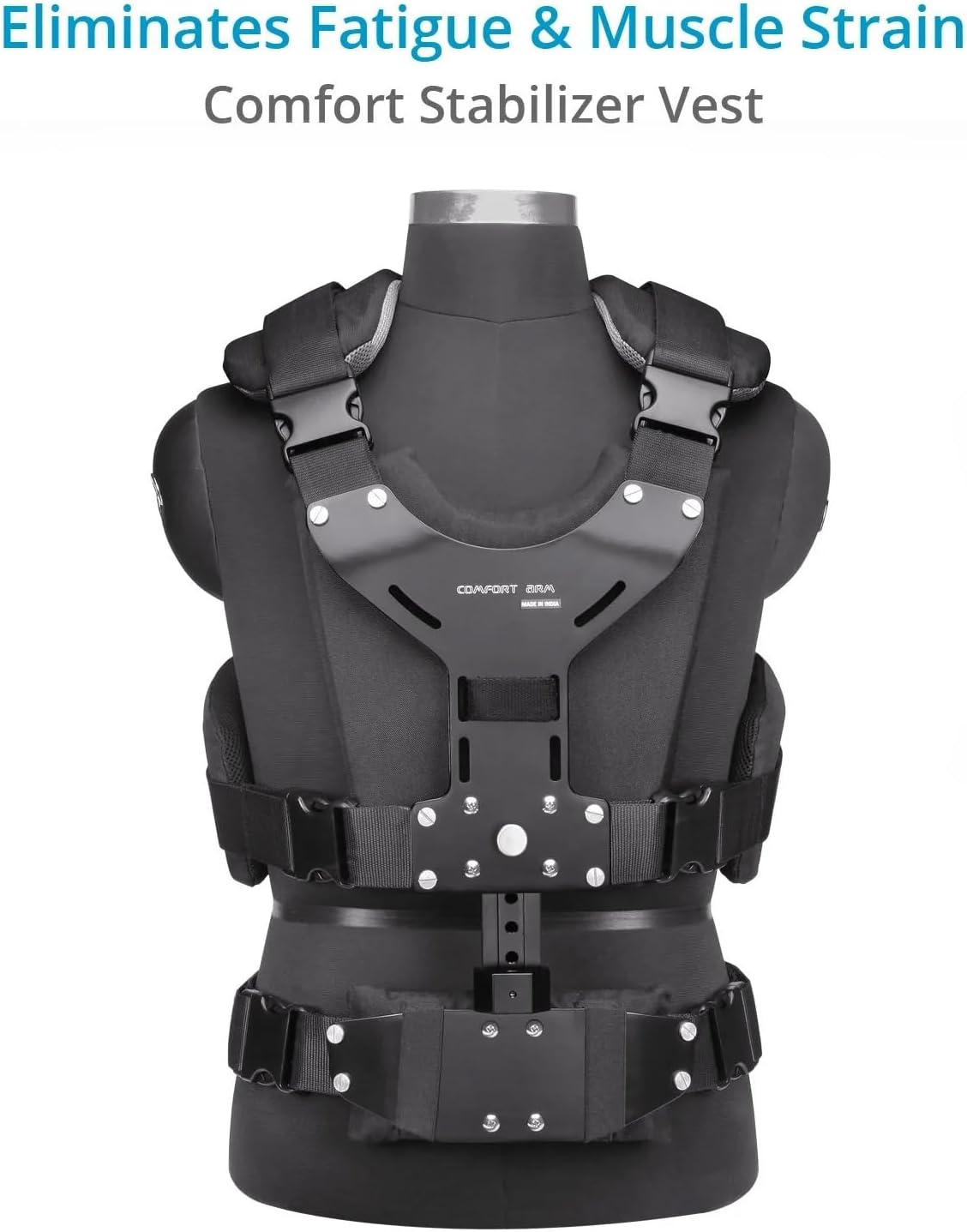
If you’ve ever watched a professional camera operator glide across a wedding reception or film set without a single shake in the shot, you’ve seen a vest-and-arm system at work. Here’s the plain-language version: a stabilizer vest is a wearable harness that transfers camera weight from your arms and wrists to your torso and hips. The iso-elastic arm — the articulated, spring-loaded linkage that connects the vest to your camera or gimbal — absorbs vertical bounce from walking. Together, they’re what make the “floating camera” effect possible for run-and-gun and event work. If you’re already using an electronic gimbal (a motorized device like a DJI RS 3 Pro or Tilta Hydra that fights rotational shake), adding a vest-and-arm system handles the vertical bounce the gimbal can’t. The two work together. The question this article answers: what do budget vest-and-arm options actually cost you — not just in dollars, but in reliability, safety, and lost shooting time — compared to what you gain?
| EDITOR'S PICK[FLYCAM Galaxy Dual Arm and Vest](https://www.amazon.com/dp/B00JBZIJMG?tag=greenflower20-20)… | Mid-tierFLYCAM Comfort Arm & Vest for H… | Budget pick[SMALLRIG Universal Basic Camera](https://www.amazon.com/dp/B09Q6DJ5VS?tag=greenflower20-20)… | |
|---|---|---|---|
| Max payload | 10kg/22lb | 5kg/11lb | — |
| Arm count | 2 | 1 | — |
| Vest included | ✓ | ✓ | — |
| Waist range | — | 28-60" | — |
| Material | — | Stainless-steel | — |
| Adjustable arm | — | Tension knob | — |
| Price | $448.00 | $209.00 | $99.99 |
| See on Amazon → | See on Amazon → | See on Amazon → |
The Payload Problem Nobody Warns You About
The number printed on a budget vest-and-arm box is almost never the number that matters on your shoot.
Here’s the math that trips up a lot of operators:
By the numbers — a typical mirrorless gimbal rig:
- Sony FX3 body: ~1.7 lb
- 24–70mm f/2.8 GM II: ~1.7 lb
- SmallRig cage + monitor + follow focus: ~2.0 lb
- DJI RS 3 Pro gimbal body: ~3.3 lb
- Total at the dovetail: ~8.7 lb
Budget vest systems from Flycam and Galaxy routinely list payload ratings of 6–10 kg (roughly 13–22 lb) on paper. That sounds comfortable. But aggregated long-run reviews on ProVideoCoalition’s stabilizer roundup and Cinema5D’s operator experience coverage consistently surface the same pattern: rated payload is a static load spec, not a dynamic one. Walking generates impact forces. Pivoting on a dance floor multiplies arm torque. Operators who push a budget arm to its rated ceiling in real motion work report degraded spring tension, joint slop, and — critically — arm sag mid-shot within a single long event day.
The practical ceiling for budget arms in dynamic use is typically 60–70% of the stated spec. For a system rated at 6 kg, plan on a real-world working load closer to 4 kg (about 8.8 lb). Your gimbal-plus-FX3 rig is already right at that edge.
This matters at the purchase decision: if you’re carrying a full cinema-class body like a BMPCC 6K Pro in a cage with an RS 3 Pro underneath, you’re likely already over the practical dynamic capacity of any sub-$400 vest arm — regardless of what the spec sheet says.
The Loose Screw Problem: A Consistent Red Flag Across Budget Systems
This is the finding that surfaces most clearly across buyer reviews, and it deserves directness: multiple independent owners of the Flycam Comfort Arm and the Galaxy Dual Arm report receiving units with loose or missing screws out of the box.
This isn’t an isolated quality-control complaint. The pattern appears across aggregated reviews — separate buyers, separate purchase dates — explicitly warning others to perform a complete hardware audit before mounting any camera. No Film School’s coverage of budget stabilizer systems specifically notes that articulated arm joints and vest-plate attachment hardware are the two highest-risk areas for factory under-torquing.
What to check before your first load:
- Every pivot-joint bolt on the arm links, with appropriate torque (don’t just hand-tighten)
- The dovetail plate locking screw and its safety catch
- The vest-to-arm socket mount — both the threaded collar and any retention pin
- Chest plate adjustment bolts on the vest harness itself
That pre-flight takes about 15 minutes and a basic hex key set. Skip it and you’re risking a dropped gimbal rig. A reviewer who owns professional Steadicam-grade gear and purchased the Galaxy Dual Arm specifically to evaluate the budget tier makes an important counter-point: after performing that hardware audit, he found the Galaxy Dual Arm genuinely impressive for its price and payload category. His conclusion isn’t that the product is unsafe — it’s that it requires informed setup that budget buyers aren’t always warned about. That’s a meaningful distinction.
The Flycam Comfort Arm earns a specific endorsement in a different context: one operator adapted it for electronic gimbal use by adding a rotating plate — a third-party ball-head adapter inserted between the arm socket and the gimbal handle — that allowed the payload to self-level and rotate independently as he moved through a venue. This is a creative modification that turns a bare-camera-oriented arm into a more gimbal-compatible tool, and it’s worth considering as a ~$30–$50 add-on to any Flycam system purchase.
Shoulder Rigs as the Alternative: Where They Win and Where They Don’t
A shoulder rig is a different category of stabilization. Instead of redistributing weight through a vest to your hips, a shoulder rig sits on your shoulder and uses your body mass as a counterweight against the camera. You absorb shake rather than float above it. For short bursts — documentary interviews, run-and-gun news work, quick B-roll passes — shoulder rigs offer faster setup and lower cost of entry than vest systems.
But there’s a safety concern in this category that warrants plain-language coverage.
On the Tilta lightweight shoulder rig: at least one owner has reported that the center handlebar assembly twisted under minimal force — specifically, with a modest camera load and no aggressive movement — nearly dropping the rig. Premium Beat’s coverage of shoulder rigs for event videography notes that handlebar rigidity is a non-negotiable safety spec, not an ergonomic preference. A twisted handle during a live event doesn’t just mean a dropped camera; it means a camera falling near clients or guests.
This report shouldn’t be overstated — it reflects one documented owner experience, not a statistical failure rate. But given the Tilta rig’s marketing toward mirrorless operators who may mount a Sony FX3 with a cage and lens, it is a risk worth naming explicitly. Before committing any heavy mirrorless package to a lightweight shoulder rig, check handlebar torque specs, verify locknuts are fully tightened, and do a loaded stress check (mount your rig, hold it over a padded surface, and apply lateral handlebar force) before shooting near clients.
The Cam Caddie Scorpion EX occupies a different sub-niche in the shoulder support category. One documented user case from an NYC event photographer with a fractured elbow is worth highlighting — not as a gimmick, but as a genuine accessibility consideration. The Scorpion EX’s grip-forward, body-braced design allowed this operator to continue working a high-season event load while managing a legitimate mobility limitation. Cinema5D’s event videography coverage reinforces that this kind of ergonomic flexibility — the ability to shift load pathways when a standard shooting position isn’t available — has real production value beyond the average healthy shooter’s use case.
Vest-and-Arm vs. Shoulder Rig for All-Day Event Shooting: The Decision Frame
This is where most buyers get it wrong: they pick a category based on price rather than the nature of the shoot.
If X, then Y:
-
If your shoot is 6+ hours, you’re on your feet continuously, and payload exceeds 4 kg (gimbal included): a vest-and-arm system is the correct category. Even a budget system properly set up will reduce operator fatigue significantly compared to a shoulder rig at that duration and weight. The shoulder rig asks your neck, trapezius, and deltoids to absorb everything. The vest asks your hips and core. For an 8-hour wedding, that difference is measurable in your ability to hold steady in hour seven.
-
If your shoot is under 3 hours, involves frequent repositioning between static setups, or requires moving through tight spaces like reception hall corridors: a shoulder rig wins on mobility and setup speed. The vest-and-arm system’s arm needs calibration for each payload change, and the vest itself has meaningful bulk in crowded venues.
-
If you have a physical limitation or injury affecting shoulder or arm stability: the Cam Caddie Scorpion EX and similar body-braced designs offer a load path that bypasses the shoulder joint, and that’s worth more than any spec comparison.
-
If your gimbal payload exceeds 8 lbs total (body + lens + cage + gimbal): disqualify all budget vest arms from the shortlist and move directly to mid-tier options. The hidden cost of an undersized arm isn’t just bad footage — it’s a dropped rig.
Frequently Asked Questions
Can a Flycam vest system support a gimbal rather than a bare camera? Yes, with a modification. The Flycam Comfort Arm’s standard dovetail is designed for direct camera mounting, but operators have successfully adapted it for gimbal use by inserting a rotating plate or ball-head adapter between the arm socket and the gimbal handle. This allows the payload to self-level and rotate as you move. Without that adapter, the arm constrains the gimbal’s yaw movement in a way that defeats part of its stabilization value.
Why do budget vest systems arrive with loose screws, and what should you check before use? Budget vest-and-arm systems are typically assembled and packaged at volume without torque-spec verification on individual units. Shipping vibration can further loosen factory-assembled hardware. Before mounting any camera, check and tighten every pivot-joint bolt, the dovetail locking screw and safety catch, the vest-to-arm socket mount, and the chest plate adjustment hardware. Use a hex key set, not finger tension. This takes 15 minutes and prevents a dropped rig.
Is a shoulder rig or a vest-and-arm system better for all-day event shooting? For events exceeding 6 hours with a payload above 4 kg (typical when carrying a mirrorless body plus gimbal), a vest-and-arm system distributes fatigue more sustainably than a shoulder rig. Shoulder rigs concentrate load on the neck and trapezius; vest systems route it through the hips and core. That distinction is largely academic for a 2-hour shoot and meaningfully physical for an 8-hour wedding.
What payload do these budget vest systems actually support in real-world use? Budget arms rated at 6–10 kg should be treated as having a dynamic working capacity of roughly 60–70% of that rating — approximately 4 kg for a 6 kg-rated arm. Static load specs don’t account for the impact forces generated by walking, turning, or ascending stairs. Operators who push budget arms to their rated ceiling in active use consistently report arm sag and joint slop within a single long event day.
Is the Tilta lightweight shoulder rig safe for heavy mirrorless rigs like the Sony FX3? At least one owner has reported handlebar twist under minimal load, nearly resulting in a dropped camera. This is a documented single-user experience, not a confirmed systematic failure rate. That said, handlebar rigidity is a safety spec. Before mounting a heavy mirrorless package on any lightweight shoulder rig, verify handlebar torque specs, ensure all locknuts are fully tightened, and perform a loaded lateral-force test over a padded surface before shooting near clients.
Where to go next: If you’re working through a payload calculation for your specific gimbal rig, the decision between a budget arm and a mid-tier system often comes down to a single number: total weight at the dovetail. Run that number first — body plus lens plus cage plus accessories plus gimbal — then match it against 60% of the vest arm’s rated payload. If you’re over, the budget category is already off the table, and the mid-tier systems are worth the comparison.