September 3, 2026 • Declan Merritt • 10 min reading time • Prices verified June 17, 2026
Tripod Dolly Buying Guide: What Actually Rolls Well Under Real Studio Conditions
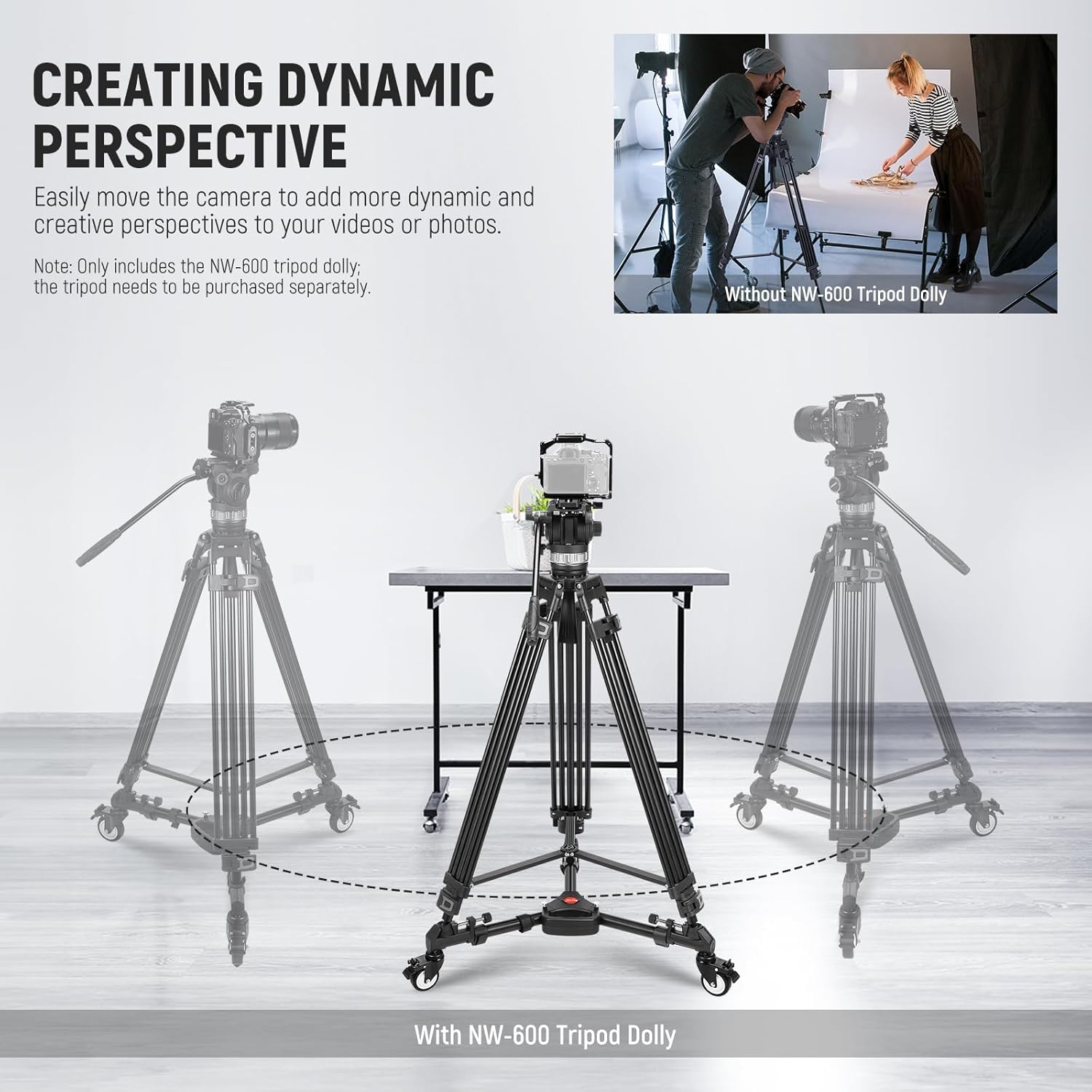
A tripod dolly is exactly what it sounds like: a rolling base — usually a Y-shaped or triangular frame with three wheels — that your tripod legs sit in so you can push the whole camera setup smoothly across a floor. Instead of picking up and repositioning a tripod between shots, you just roll it. It sounds simple, and it mostly is. But “smooth roll” turns out to be a real engineering problem, and the gap between a $30 plastic wheel-set that skitters sideways and a properly designed rubber-wheel dolly that tracks a straight line is immediately visible in footage. If you’re shooting in a studio, doing product work, or running interviews where the camera needs to creep forward during a take, the dolly you’re sitting on matters more than most people expect before they’ve bought the wrong one.
This guide is built around what owners actually report, documented spec discrepancies that have surprised buyers, and the decision logic you need if you’re mid-production and choosing between three or four options in the $40–$150 range. You’ll get the tradeoffs named explicitly, a look at the load rating confusion that has caught a lot of people off guard, and a clear if-then framework at the end.
| EDITOR'S PICKCayer TD03 Tripod Dolly | Mid-tierPhotography Tripod Dolly | Budget pickNEEWER Photography Tripod Dolly | |
|---|---|---|---|
| Max load | 66 lbs | — | 50 lbs |
| Carrying case | ✓ | ✓ | — |
| Adjustable mounts | — | ✓ | — |
| Fits | Tripods & light stands | Most tripods | DSLRs & camcorders |
| Price | $59.99 | $59.99 | $42.95 |
| See on Amazon → | See on Amazon → | See on Amazon → |
The Load Rating Problem You Need to Know About Before You Buy
Let’s start with the issue that generates the most post-purchase friction in this product category: the Neewer tripod dolly load rating discrepancy.
Multiple owners across aggregated reviews have flagged a genuine mismatch between what the Amazon product listing states — 50 lbs capacity — and what is printed on the physical product and its included documentation, which specifies 33 lbs. This isn’t a minor rounding difference. It’s a 17-pound gap that changes the math entirely if you’re running a mirrorless body in a cage with a heavier lens, a matte box, and a fluid head on top. That combination can approach or exceed 33 lbs without being an unusual or heavy-duty rig.
What this means in practice: If you’re planning a rig that sits between 33 and 50 lbs and you’ve been counting on the Amazon-listed spec, you should treat the 33 lb figure as the operative limit until Neewer publishes clarifying documentation. Relying on the listing spec and loading past 33 lbs on a physical product rated for 33 lbs creates real risk — both to your gear and to the dolly’s wheel bearings and frame joints over time.
Pro Video Coalition’s overview of tripod system selection consistently reinforces a principle worth repeating here: always verify payload specs against manufacturer documentation, not retail listing copy, because listing copy is updated inconsistently and sometimes reflects an older or different regional product variant.
By the Numbers: Dolly Load Ratings at a Glance
| Dolly | Listed Payload (Retail) | Documented / Physical Rating | Wheel Diameter |
|---|---|---|---|
| Neewer Tripod Dolly | 50 lbs (Amazon listing) | 33 lbs (product docs) | ~2 in |
| SmallRig Quick-Lock Dolly | Per manufacturer spec | Consistent with listing | ~2.5 in |
| Cayer TD03 | Per manufacturer spec | Consistent with listing | 3 in |
| Generic Heavy-Duty (rubber wheel) | Varies by seller | Varies — verify | 3 in |
The 3-inch wheel column is doing real work in this table — more on that below.
Wheel Size and Surface Transitions: Why 3-Inch Rubber Wheels Change the Conversation
The most underrated spec in a tripod dolly is wheel diameter, and it’s almost never discussed in the product copy. Smaller wheels — the 2-inch plastic or semi-rubber casters common on budget dollies — are reasonably smooth on sealed concrete or hardwood, but they stall on low-pile carpet, catch on floor transitions (the gap between a tiled entry and a wood studio floor, a garage lip, a cable run), and transmit more vibration upward into the tripod because they can’t roll over surface irregularities smoothly.
Owners of the Cayer TD03 consistently note that its 3-inch wheels handle surface transitions better than expected for the price tier — including rolling over a garage lip to get equipment outside, a use case that would strand most small-wheel dollies. The same pattern shows up for the generic heavy-duty dolly with 3-inch rubber wheels, which earns repeated praise in long-run reviews specifically for vibration-free rolling relative to its cost. When reviewers describe footage from dolly moves as “clean” or “not floaty,” wheel diameter and rubber compound are doing the invisible work.
Studio Binder’s tripod guide notes that surface type is one of the first questions production crews should ask when evaluating support equipment for a new location — and it’s a variable that changes which dolly is the right call. A shoot that’s 100% on sealed studio hardwood has different requirements than one split between studio, carpet, and outdoor concrete.
Carpet specifically: none of the dollies in the sub-$150 tier roll freely on medium or high-pile carpet. The 3-inch rubber wheels perform better on low-pile carpet than 2-inch wheels, but “better than the alternative” isn’t the same as “good.” If you’re regularly shooting on carpet — corporate event environments, broadcast sets with carpeted studio floors — a dolly is either a non-starter or needs to be used with a section of masonite or lauan board laid down as a track surface.
The SmallRig Quick-Lock Dolly: When Build Quality Creates Its Own Friction
SmallRig’s Quick-Lock dolly has a strong reputation in its tier for rolling smoothly and feeling solidly constructed — owners in aggregated reviews consistently use words like “tight,” “confident,” and “no play” when describing the rig’s build. For a studio setup where the camera position is set and held for extended periods, it performs well and the price-to-quality ratio is genuinely favorable.
The documented friction point, and it’s real: the wheel lock mechanism is difficult to release quickly during active shooting. Multiple owners across long-run reviews raise this specifically. The locks engage reliably, which is the primary function — but releasing them fast during a run-and-gun situation or a handheld-to-dolly transition takes more attention than it should. For a controlled interview setup or a product photography studio where you lock the dolly, shoot a sequence, and don’t need to unlock until the next setup, this is a minor inconvenience. For documentary work, event coverage, or any situation where you’re repositioning the camera more than three or four times per hour under time pressure, the lock mechanism becomes a genuine workflow tax.
No Film School’s camera movement guide draws a useful distinction between “studio motion” (deliberate, repeatable, locked between moves) and “run-and-gun motion” (continuous, reactive, requiring fast transitions) — and most tripod dollies are designed around the first mode, not the second. The SmallRig Quick-Lock’s behavior fits that pattern exactly.
Cinema5D’s camera support fundamentals coverage similarly emphasizes matching support equipment to the production mode you’re actually in, rather than the production mode you wish you were in. The SmallRig is a studio tool that will frustrate you if you try to use it like a field tool.
Tripod Compatibility: Leg Spread and the Adjustment Question
One of the most common pre-purchase questions across all dolly tiers: will this work with my specific tripod? The honest answer is: it depends on leg spread, and most budget dollies offer adjustable sockets rather than fixed ones — but the adjustment range varies and isn’t always documented precisely.
Most tripod dollies in the $40–$150 tier use a sliding or locking socket at the end of each dolly arm that accepts the tripod leg and can be repositioned to match wider or narrower leg spreads. The Cayer TD03 and the generic heavy-duty rubber-wheel dolly both follow this pattern and are reported by owners as compatible across a range of standard 75mm, 100mm, and mid-range tripod leg spreads. The SmallRig Quick-Lock dolly uses a similar adjustable approach.
The edge cases to watch: Very wide-leg tripods (some broadcast-tier sticks that spread aggressively for stability) and very narrow travel tripods can fall outside the adjustment range on the short end or long end. If your tripod legs have an unusual cross-section — some carbon-fiber legs are oval rather than round — socket fit can be loose. B&H Photo Video’s tripod accessories category documentation recommends confirming leg tip diameter compatibility before purchase, particularly for higher-end leg systems.
Floor Marking and Carrying Cases: Two Questions Owners Ask Too Late
Hardwood floors: Rubber wheels, when clean, generally do not mark finished hardwood floors under normal rolling loads. Dirty wheels — dust, grit, small debris picked up from concrete or outdoor surfaces — can scratch. Owners across multiple dolly categories report no marking on sealed hardwood under clean-wheel conditions, but this is a “keep the wheels clean” situation, not a “rubber is inherently safe” guarantee. Check wheels before rolling onto finished flooring.
Carrying cases: No, carrying cases are not standard inclusions across this product tier. The SmallRig Quick-Lock dolly and Cayer TD03 ship without dedicated cases. The generic heavy-duty rubber-wheel options similarly ship in basic packaging with no carry solution included. If you’re moving this equipment between locations, plan on a padded bag purchase separately or use a gear bin. This isn’t a dealbreaker, but it’s a line item people consistently miss in total cost of ownership.
Frequently Asked Questions
Does the Neewer tripod dolly actually support 50 lbs or 33 lbs? The Amazon listing states 50 lbs, but the physical product and its documentation specify 33 lbs. Treat 33 lbs as the operative limit. If your rig approaches or exceeds that figure, look at a higher-capacity option or verify directly with Neewer’s current documentation.
Will any of these dollies work on carpet without getting stuck? Not reliably on medium or high-pile carpet. The 3-inch rubber wheels on the Cayer TD03 and the generic heavy-duty option handle low-pile carpet and surface transitions better than small-wheel alternatives, but for sustained carpet shooting, lay down a hard surface section first.
How quickly can the SmallRig Quick-Lock dolly be locked and unlocked mid-shoot? Owners consistently report that locking is fast but unlocking under time pressure is awkward. Plan for it. If your shoot requires frequent, fast repositioning, the lock mechanism will slow you down.
Are these dollies compatible with any tripod leg spread, or only specific sizes? Most use adjustable sockets that cover a range of standard leg spreads. Verify the adjustment range against your tripod’s specific leg spread and leg tip diameter before purchasing — especially for broadcast-tier or unusually wide-stance tripods.
Do the wheels on these dollies leave marks on hardwood floors? Rubber wheels on clean dollies generally don’t mark sealed hardwood. The risk is dirty wheels carrying grit from other surfaces. Clean wheels before moving onto finished floors.
Is a carrying case included with all of these dollies? No. Cases are not standard inclusions at this price tier. Budget for a padded bag or transport solution separately.
The Decision Rule
If you’re shooting in a controlled studio on hardwood or sealed concrete, your rig is under 33 lbs, and you set positions deliberately rather than repositioning under pressure: the SmallRig Quick-Lock dolly’s build quality and roll smoothness make it the natural pick. The lock friction is irrelevant if you’re not fighting it constantly.
If your surfaces are mixed — studios that include carpet sections, location work with floor transitions, outdoor-to-indoor moves — and you want a dolly that handles transitions without stalling: the Cayer TD03’s 3-inch wheels earn their reputation, and owners’ real-world reports on surface versatility are consistent enough to trust.
If your rig is above 33 lbs and you were planning on the Neewer: recalculate. Either pull weight from the rig or move to a higher-rated platform. Don’t trust the listing spec on this one.
For the price-conscious setup where vibration-free rolling matters more than brand recognition: the generic heavy-duty 3-inch rubber-wheel dolly’s owner reviews are consistently strong for its tier, and the value math is hard to argue with at the price point.
Your next step: confirm your rig’s total payload — body, lens, head, cage, accessories, all of it — before you finalize the dolly choice. That single number narrows the field faster than any other variable.