August 13, 2026 • Declan Merritt • 11 min reading time • Prices verified June 17, 2026
Tripod Dollies Tested: SmallRig, Neewer, and the Vidpro Skater — What Rolls Well and What Rolls Away
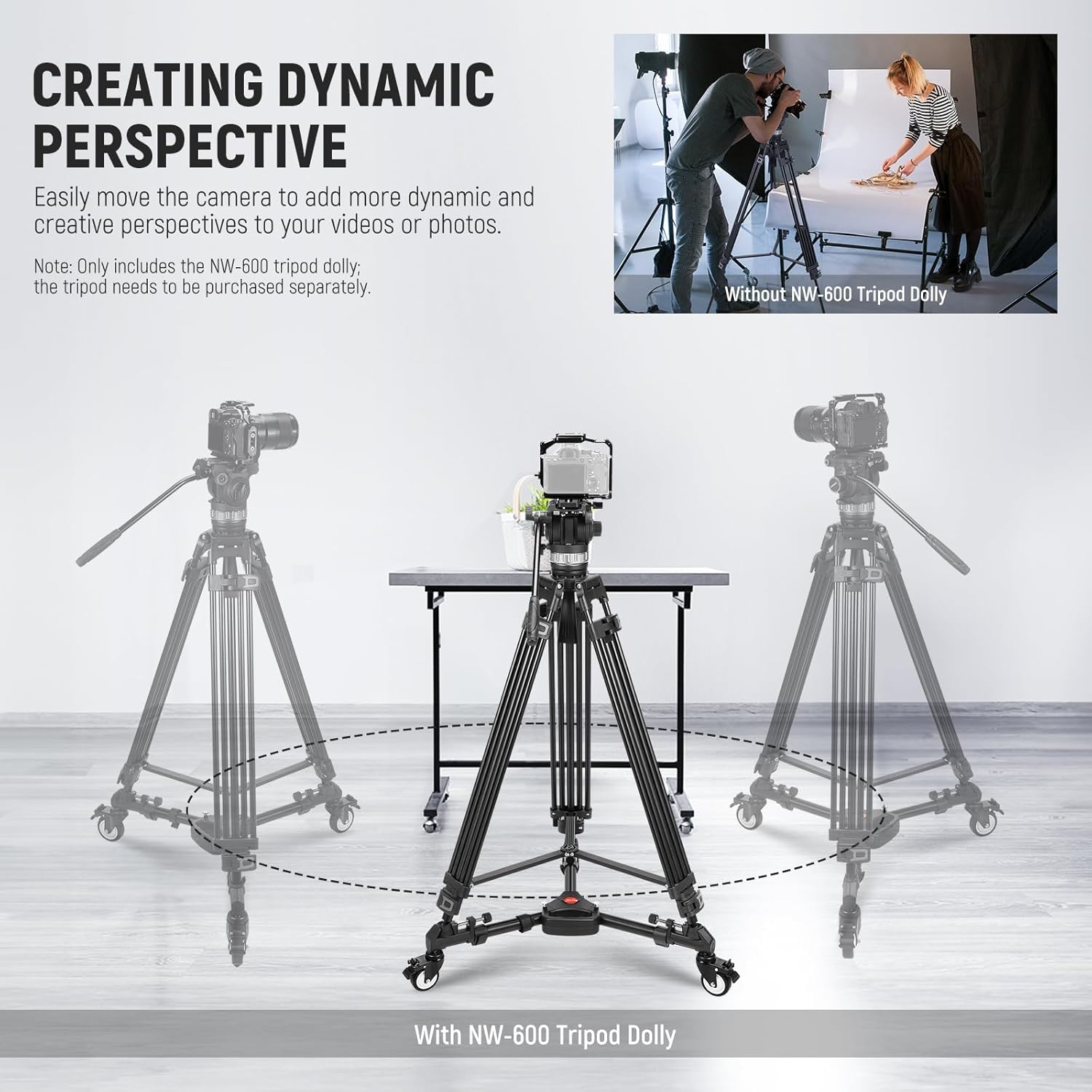
A tripod dolly is exactly what it sounds like: a wheeled platform that sits under your tripod legs so you can roll the whole rig — camera, head, and all — across a floor in one smooth push. No track required, no dolly grip required, no $800 rental fee. For run-and-gun documentary work, corporate video, or any situation where you want a slow push-in or a lateral slide without committing to full slider infrastructure, a tripod dolly is one of the most dollar-efficient tools in the kit. They range from dead-simple three-wheel rubber rigs to locking quick-release platforms to motorized smart-car contraptions that move on a programmed path. The catch — and there is always a catch — is that “smooth” depends enormously on your floor surface, your payload, and whether the product listing is being honest about its own weight capacity. This comparison pulls together verified specs, aggregated buyer reports, and plain-text editorial guidance so you know which dolly earns a place in your kit and which one earns a return label.
| EDITOR'S PICKNeewer 3 Wheels Wireless Video… | Mid-tierNEEWER Photography Tripod Dolly | Budget pickVidpro SK-22 Professional Skate… | |
|---|---|---|---|
| Type | Motorized track dolly | Tripod dolly | Skater dolly |
| Capacity | — | 50 lbs | 25 lbs |
| Wheel size | — | 3" | — |
| Speeds | 3 | — | — |
| Mount points | — | — | 7 |
| Remote control | ✓ | — | — |
| Price | $73.89 | $42.95 | $41.00 |
| See on Amazon → | See on Amazon → | See on Amazon → |
The Short Version: Four Dollies, Four Very Different Use Cases
Before we go deep, here is the decision matrix at a glance. Each row is expanded in a full H3 section below, including a tier marker so you can self-select by budget and use case.
| Dolly | Best for | Listed Capacity | Smoothness Ceiling |
|---|---|---|---|
| SmallRig Quick-Lock | Hard-floor repeat shooters | ~44 lbs | High on hard floors |
| Neewer Tripod Dolly | Budget buyers (read the capacity note) | 50 lbs listing / 33 lbs manual | Moderate |
| Generic 3-inch rubber-wheel | Budget secondary rigs, mixed floors | ~33–44 lbs typical | Surprisingly high |
| Vidpro SK-10 Skater | Cinematic moves, controlled environments | ~22 lbs | High with caveats |
| Neewer Motorized Dolly Car | Solo operators, smooth studio floors | ~11 lbs | High on smooth surfaces only |
Now let’s unpack each option properly.
Deep Comparison: Five Dollies Evaluated
SmallRig Quick-Lock Dolly
SmallRig’s Quick-Lock Dolly sits in the mid-range of passive tripod dollies and consistently earns strong aggregate ratings from buyers who care about one thing above all else: a smooth, predictable roll. On hardwood, tile, and sealed concrete, the dolly tracks cleanly and does not fight you mid-move. The locking legs — the “Quick-Lock” part of the name — clamp down on spread tripod legs to prevent the platform from sliding out from under the rig during a take.
Here is the nuance that long-run reviewers flag explicitly and that is worth taking seriously: the locking mechanism is stiff enough that releasing it quickly during a fast-paced shoot is genuinely inconvenient. If you are the kind of operator who locks between takes and then needs to rapidly reposition — think event work, run-and-gun documentary, anything with compressed turnarounds — you will feel that friction in your workflow. The lock is doing its job; the tradeoff is that it does it a little too enthusiastically when you are in a hurry.
On payload, the SmallRig handles setups well into the mid-tier mirrorless range. A Sony FX3 with a small zoom and a fluid head sits comfortably inside its envelope. Where owners note limitation is softer floors: carpet in particular degrades the roll considerably, and that is a hardware physics problem, not a SmallRig-specific issue. No passive rubber-wheel dolly rolls cleanly on carpet.
As No Film School covers in their camera movement fundamentals editorial coverage, the smoothness of any dolly move is ultimately a product of surface, payload, and operator technique — not hardware alone. The SmallRig gives you excellent hardware; the floor and your push do the rest.
If X, then Y: If you shoot primarily on hard floors and want one dolly you can lock, roll, and trust across a full day of work, this is the strongest performer in the passive category.
NEEWER
$42.95
In stock on Amazon
Check price on AmazonNeewer Tripod Dolly
Let’s address the issue immediately, because it is the kind of thing that earns a return label or — worse — a bent head mount.
The Neewer tripod dolly’s Amazon product listing states a 50-pound weight capacity. The product manual and promotional material that ships with the unit states 33 pounds. A verified buyer surfaced this discrepancy explicitly in their review, and it is not a rounding issue or a unit-conversion artifact. Seventeen pounds is a meaningful margin when you are calculating payload: that is the difference between a mirrorless body with a kit lens and a mirrorless body with a mid-range zoom, a cage, a small follow focus, and a half-tank of V-mount power.
StudioBinder’s editorial coverage of camera support planning — published under their “Types of Camera Movement and When to Use Them” piece — notes that payload calculation should always account for every element on the rig: body, lens, cage, accessories, and the head itself, not just the camera body. If you are using the 50-pound figure as your planning ceiling and the actual safe working load is 33 pounds, you are potentially running 17 pounds hot. The editorial recommendation here is to treat the 33-pound figure as the real constraint until Neewer corrects the discrepancy in print.
On roll quality, the Neewer delivers a workable result on smooth hard floors within its honest payload range. Aggregated buyer reports describe nothing exceptional and nothing catastrophic — it is a functional passive dolly for light loads. At the price point Neewer occupies, the capacity confusion is the only thing that bumps it below a clean recommendation.
If X, then Y: If you are under 30 pounds of actual payload and need the most affordable entry point, the Neewer works — but budget your load conservatively against the 33-pound manual figure, not the listing’s 50-pound claim.
Vidpro
$41.00
In stock on Amazon
Check price on AmazonGeneric 3-Inch Rubber-Wheel Dolly
This category — unbranded or house-brand three-wheel rubber-wheel dollies available across multiple retailers — consistently exceeds expectations in ways that name-branded options at the same price tier do not. Multiple buyers across aggregated reviews specifically praise stability across a range of floor surfaces as the standout attribute. The wider rubber wheels distribute load more evenly and provide more floor contact than narrow caster-wheel designs, which is why owners report usable rolls even on slightly irregular surfaces like older hardwood or low-nap commercial carpet.
PremiumBeat’s editorial coverage on camera support selection — published under “How to Choose the Right Camera Support for Your Production” — addresses floor contact geometry as one of the primary determinants of roll quality. Wide rubber outperforms narrow hard casters on almost every surface that is not perfectly smooth polished tile, and the generic 3-inch designs have been capitalizing on this physics reality while branded options chase feature specs.
The limitation is build confidence: there is no brand accountability, no customer support infrastructure, and quality control varies across batches. For a shooter who needs a reliable B-unit dolly for a low-payload secondary camera, this category earns genuine consideration. For any situation where the rig is carrying a meaningful cinema payload, you want the tracked build quality of a named-brand option.
If X, then Y: If you are equipping a secondary camera position with a mirrorless body and a prime lens and want to stretch your budget, this category delivers real value. If you are rolling a heavier cinema body with a zoom and a cage, spend up to a dolly with verifiable build standards.
Vidpro
$41.00
In stock on Amazon
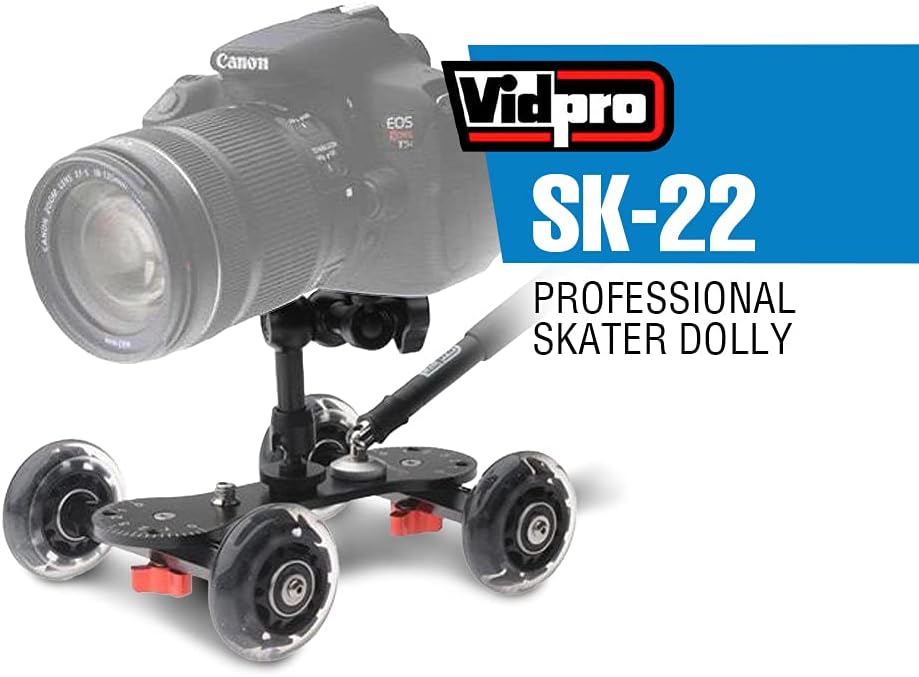
Check price on AmazonVidpro SK-10 Skater Dolly
The Vidpro SK-10 operates on a different design premise than the tripod dollies above. It is a skater-style platform dolly — the camera mounts directly to the dolly rather than sitting on a tripod — and it produces notably smooth, quiet lateral and push-pull moves that buyers in aggregated reviews consistently describe as genuinely cinematic.
Two limitations surface repeatedly in long-run owner reports:
- The camera mount is loose. Multiple buyers flag noticeable play in the mount, which translates to micro-wobble in the shot — visible in close inspection of footage, particularly on longer focal lengths where movement magnifies.
- The handle is short. Operators pushing the dolly for lateral moves report that the short handle reduces leverage and makes smooth deceleration harder to control, especially at the end of a move.
On the positive side: the SK-10 explicitly supports curved tracking shots by adjusting the wheel angle, which is a genuinely useful capability for shooting around a subject or a product. No Film School’s camera movement fundamentals coverage notes that curved tracking moves are among the most narratively powerful motions in the filmmaker’s toolkit — and having that option at this price tier is meaningful. The limitation is that executing it well requires a stable, smooth surface and a light payload.
If X, then Y: If your primary use case is controlled-environment product work or interview B-roll where you want elegant lateral or arcing moves, and you are willing to address the mount looseness with a simple lock-nut fix, the Vidpro earns its place. If you need zero-tolerance mount stability on a longer lens, the loose mount is disqualifying without modification.
NEEWER
$42.95
In stock on Amazon
Check price on AmazonNeewer Motorized Dolly Car
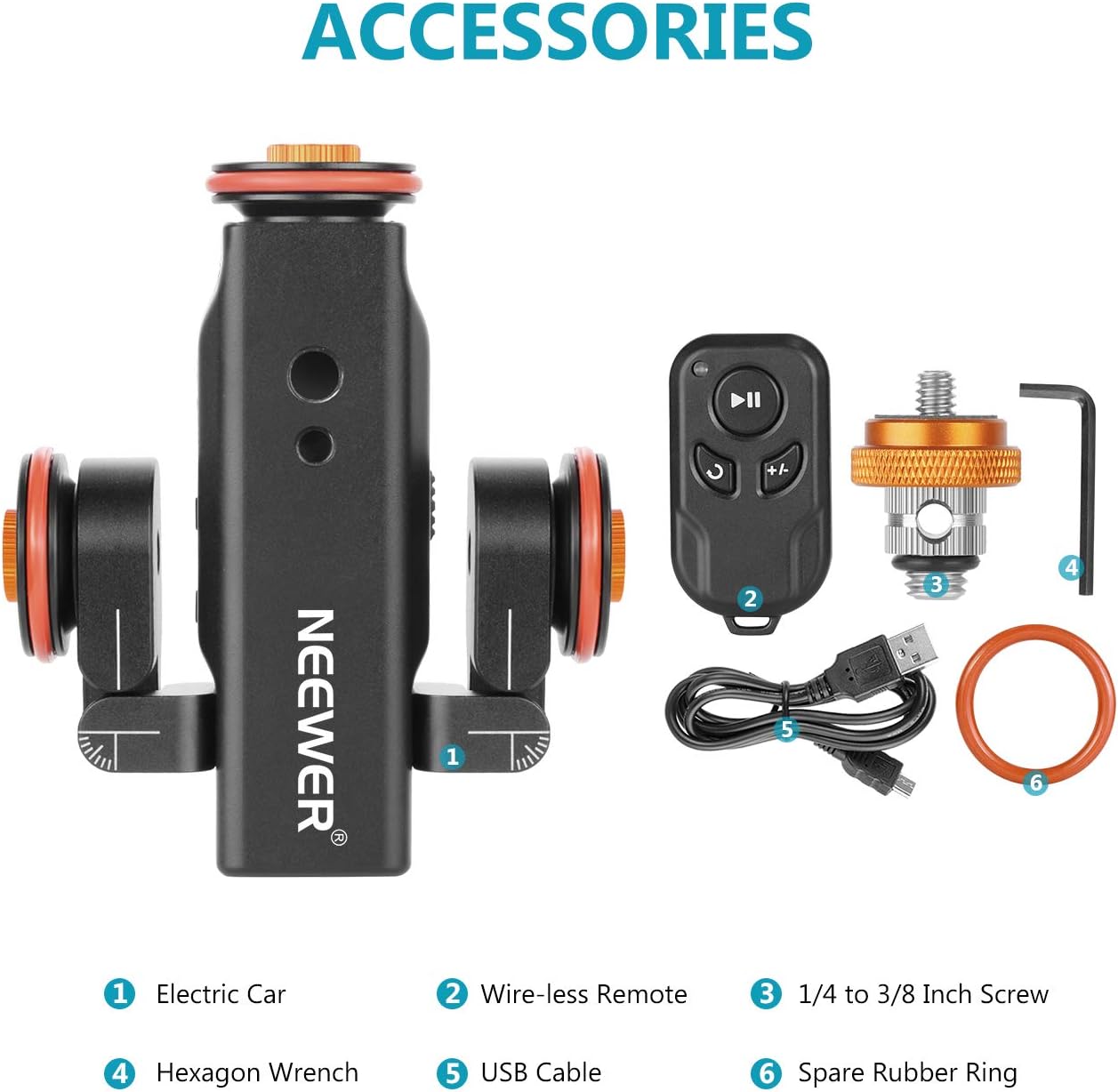
The Neewer Motorized Dolly Car operates in a different category entirely — it is not a tripod support platform but a self-propelled camera carrier designed for solo operators who need repeatable programmed moves without a second person on set. Buyers in aggregated reviews note it is heavier than it looks, with the motor and chassis adding meaningful mass to your kit bag. The critical operational constraint is clear: smooth surfaces are non-negotiable. On anything other than polished hard flooring — tile, sealed concrete, smooth hardwood — the motorized system picks up surface irregularities as vibration that reads in the footage.
Within those constraints, operators report that the autonomous move capability genuinely delivers for product shooting and social content work where consistency of motion across multiple takes is valuable. For a solo commercial shooter who needs the camera to travel the same path at the same speed on take five as it did on take one, that repeatability is difficult to replicate with a passive push.
If X, then Y: If you are a solo commercial shooter doing repeat product moves on a smooth studio floor, the motorized dolly car addresses a real problem. If your floors vary at all, the passive alternatives above will give you cleaner results.
Neewer
$73.89
In stock on Amazon
Check price on AmazonFrequently Asked Questions
Why does the Neewer tripod dolly list 50 lbs capacity when the product manual says 33 lbs? This is a genuine discrepancy flagged by a verified buyer, not a translation artifact or a rounding error. The Amazon listing states 50 lbs; the printed product literature that ships with the unit states 33 lbs. Until Neewer corrects this officially, treat 33 lbs as the operative safe working load for all planning purposes and load your rig conservatively against that number.
Will a tripod dolly roll smoothly on carpet? Not reliably. Carpet compresses under wheel load and creates resistance that breaks up smooth camera movement. Wide rubber wheels handle low-nap commercial carpet better than narrow hard casters, but no passive tripod dolly is a true carpet solution. For carpet environments, track-based systems or a studio dolly on a laid board surface are the appropriate tools.
Is the SmallRig Quick-Lock dolly compatible with all standard tripod leg spreads? The Quick-Lock design accommodates a range of tripod leg angles, and owners report compatibility with most standard consumer and prosumer tripods. Very wide-stance legs — common on heavier carbon-fiber systems — should be measured against the dolly’s maximum spread spec before purchase. SmallRig publishes dimensional specs in their product documentation for direct reference.
When does a motorized dolly car make more sense than a passive tripod dolly? When you need a repeatable, unattended move and you are the only person on set. A passive dolly requires a hand on the push — which means a second operator, or a tied-off pull rig. The motorized option trades floor-surface sensitivity for autonomous operation. For solo commercial shooters doing tabletop or product work on smooth studio floors, that tradeoff makes real economic sense.
Can the Vidpro skater dolly be used for curved tracking shots? Yes — the wheel angle on the SK-10 is adjustable, which allows the dolly to arc around a subject rather than traveling in a straight line. Owners confirm this works in practice on smooth surfaces with light payloads. The loose camera mount becomes a more significant factor on curved moves where the camera experiences lateral force, so addressing that before a curved-track shoot is strongly advised.
The Decision Rule
Here it is, direct:
- Need a reliable everyday tripod dolly for hard floors, light-to-mid payload: SmallRig Quick-Lock. Accept the stiff-lock tradeoff in exchange for smooth, trustworthy rolls.
- Need the lowest-cost entry point and your payload is under 30 lbs: Neewer — but plan against 33 lbs, not the listing’s 50-lb claim.
- Need multi-surface stability on a budget secondary setup: Generic 3-inch rubber-wheel. Verify build quality on arrival and keep your payload conservative.
- Need cinematic skater or curved-arc moves in a controlled environment: Vidpro SK-10. Address the camera mount before you roll on anything critical.
- Need repeatable autonomous moves on a smooth studio floor as a solo operator: Neewer Motorized Dolly Car.
Your next step: cross-reference the payload of your actual rig — body, lens, head, cage, and every accessory — against each dolly’s honest capacity before you add to cart. That number, not the marketing headline, is the one that protects your equipment and your shot.